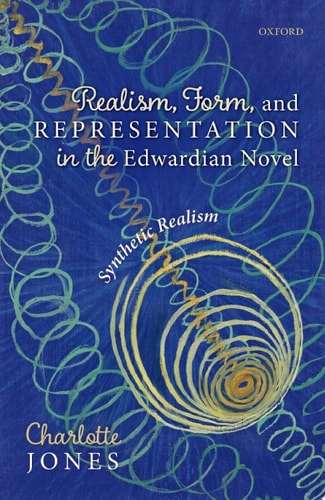
Realism, Form, and Representation in the Edwardian Novel: Synthetic Realism
0
0
As an Amazon Associate and affiliate partner, Menrva Books earns from qualifying purchases. Learn more
Author Description
The real represents to my perception the things that we cannot possibly not know, sooner or later, in one way or another', wrote Henry James in 1907. This description, riven with double negatives, hesitation, and uncertainty, encapsulates the epistemological difficulties of realism, for underlying its narrative and descriptive apparatus as an aesthetic mode lies a philosophical quandary. What grounds the 'real' of the realist novel? What kind of perception is required to validate the experience of reality? How does the realist novel represent the difficulty of knowing? What comes to the fore in James's account, as in so many, is how the forms of realism are constituted by a relation to unknowing, absence, and ineffability. Realism, Form, and Representation in the Edwardian Novel recovers a neglected literary history centred on the intricate relationship between fictional representation and philosophical commitment. It asks how—or if—we can conceptualize realist novels when the objects of their representational intentions are realities that might exist beyond what is empirically verifiable by sense data or analytically verifiable by logic, and are thus irreducible to conceptual schemes or linguistic practices—a formulation Charlotte Jones refers to as 'synthetic realism'. In new readings of Edwardian novels including Conrad's Nostromo and The Secret Agent, Wells's Tono-Bungay, and Ford's The Good Soldier, this volume revises and reconsiders key elements of realist novel theory—metaphor and metonymy; character interiority; the insignificant detail; omniscient narration and free indirect discourse; causal linearity—to uncover the representational strategies by which realist writers grapple with the recalcitrance of reality as a referential anchor, and seek to give form to the force, opacity, and uncertain scope of realities that may lie beyond the material. In restoring a metaphysical dimension to the realist novel's imaginary, Realism, Form, and Representation in the Edwardian Novel provides a new account of the realist novel's capacity to represent the limits of knowledge.
Menrva's Summary
THE THESIS
How do Edwardian realist novels represent realities that exist beyond empirical verification or logical analysis? Charlotte Jones, a scholar of early twentieth-century literature, investigates the philosophical underpinnings of the realist mode. She argues that authors of this period employed a 'synthetic realism' to address the limitations of language and perception when attempting to capture the ineffable or the non-material aspects of human experience.
THE SCOPE MAP
What You Will Find
- A theoretical framework defining 'synthetic realism' as a response to epistemological uncertainty.
- Re-evaluations of narrative techniques including omniscient narration, free indirect discourse, and causal linearity.
- Close readings of major Edwardian texts by Joseph Conrad, H.G. Wells, and Ford Madox Ford.
Scope Limits
- The analysis is restricted to the Edwardian period and does not extend to late-modernist or postmodernist developments.
- The text focuses primarily on the intersection of philosophy and literary form rather than socio-political history.
THE AUTHORITY PERSPECTIVE
Scholars identify this work as a significant contribution to the study of early twentieth-century narrative theory and the philosophy of fiction. Readers frequently note the academic density of the prose, which is intended for an audience familiar with formalist and epistemological literary criticism.
Page Count:
331
Publication Date:
2021-01-01
Publisher:
OUP Oxford
ISBN-10:
019259981X
ISBN-13:
9780192599810
History
Philosophy
Indigenous
19th Century
Literary theory
English fiction
Literary Criticism
Academic
Edwardian Literature
Community Tags
Other Editions(2)
Similar Books

Reader Comments
Share Your Thoughts
No comments yet. Be the first to share your thoughts!