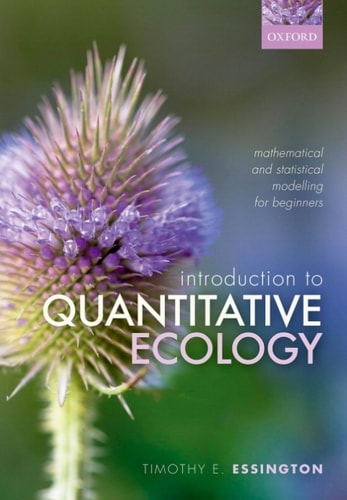
Introduction to Quantitative Ecology: Mathematical and Statistical Modelling for Beginners
0
0
As an Amazon Associate and affiliate partner, Menrva Books earns from qualifying purchases. Learn more
Author Description
Environmental science (ecology, conservation, and resource management) is an increasingly quantitative field. A well-trained ecologist now needs to evaluate evidence generated from complex quantitative methods, and to apply these methods in their own research. Yet the existing books and academic coursework are not adequately serving most of the potential audience - instead they cater to the specialists who wish to focus on either mathematical or statistical aspects, and overwhelmingly appeal to those who already have confidence in their quantitative skills. At the same time, many texts lack an explicit emphasis on the epistemology of quantitative techniques. That is, how do we gain understanding about the real world from models that are so vastly simplified? This accessible textbook introduces quantitative ecology in a manner that aims to confront these limitations and thereby appeal to a far wider audience. It presents material in an informal, approachable, and encouraging manner that welcomes readers with any degree of confidence and prior training. It covers foundational topics in both mathematical and statistical ecology before describing how to implement these concepts to choose, use, and analyse models, providing guidance and worked examples in both spreadsheet format and R. The emphasis throughout is on the skilful interpretation of models to answer questions about the natural world. Introduction to Quantitative Ecology is suitable for advanced undergraduate students and incoming graduate students, seeking to strengthen their understanding of quantitative methods and to apply them successfully to real world ecology, conservation, and resource management scenarios.
Menrva's Summary
THE THESIS
This book investigates how to bridge the gap between complex quantitative methods and practical ecological research for students who lack confidence in mathematical or statistical modeling. Timothy E. Essington, a professor with expertise in aquatic ecology and fisheries, addresses the epistemological challenge of deriving real-world understanding from simplified models. He provides a framework that integrates foundational mathematical and statistical concepts with practical implementation, specifically designed to be accessible to those without advanced quantitative training.
THE SCOPE MAP
What You Will Find
- Foundational principles of mathematical and statistical ecology
- Practical guidance on model selection, application, and analysis
- Worked examples using both spreadsheet software and the R programming language
- Discussions on the epistemology of modeling in environmental science
Scope Limits
- Does not cater to advanced specialists seeking highly theoretical or niche mathematical proofs
- Does not provide an exhaustive survey of every advanced statistical technique in ecology
THE AUTHORITY PERSPECTIVE
Experts and educators recognize this text as a highly approachable entry point for students transitioning into quantitative ecological research. Readers frequently note that the informal tone and the inclusion of both spreadsheet and R examples make the material significantly more digestible than traditional, more abstract textbooks.
Page Count:
616
Publication Date:
2021-01-01
Publisher:
OUP Oxford
ISBN-10:
0192655442
ISBN-13:
9780192655448
Science
Mathematics
Ecology
Statistics
Earth Sciences
textbook
Statics
Community Tags
Similar Books