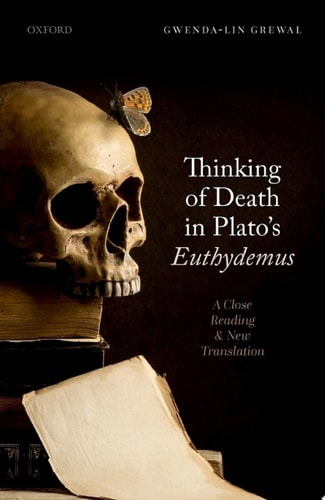
Thinking of Death in Plato's Euthydemus: A Close Reading and New Translation
0
0
As an Amazon Associate and affiliate partner, Menrva Books earns from qualifying purchases. Learn more
Author Description
Thinking of Death places Plato's Euthydemus among the dialogues that surround the trial and death of Socrates. A premonition of philosophy's fate arrives in the form of Socrates' encounter with the two-headed sophist pair, Euthydemus and Dionysodorus, who appear as if they are the ghost of the Socrates of Aristophanes' Thinkery. The pair vacillate between choral ode and rhapsody, as Plato vacillates between referring to them in the dual and plural number in Greek. Gwenda-lin Grewal's close reading explores how the structure of the dialogue and the pair's back-and-forth arguments bear a striking resemblance to thinking itself: in its immersive remove from reality, thinking simulates death even as it cannot conceive of its possibility. Euthydemus and Dionysodorus take this to an extreme, and so emerge as the philosophical dream and sophistic nightmare of being disembodied from substance. The Euthydemus is haunted by philosophy's tenuous relationship to political life. This is played out in the narration through Crito's implied criticism of Socrates-the phantom image of the Athenian laws-and in the drama itself, which appears to take place in Hades. Thinking of death thus brings with it a lurid parody of the death of thinking: the farce of perfect philosophy that bears the gravity of the city's sophistry. Grewal also provides a new translation of the Euthydemus that pays careful attention to grammatical ambiguities, nuances, and wit in ways that substantially expand the reader's access to the dialogue's mysteries.
Menrva's Summary
THE THESIS
How does the Euthydemus dialogue function as a meditation on the relationship between philosophical thought and the reality of death? Gwenda-lin Grewal, a scholar of classical philosophy, utilizes a rigorous close reading of the original Greek text to argue that the dialogue serves as a premonition of Socrates' eventual trial and execution. By analyzing the linguistic nuances of the sophist pair Euthydemus and Dionysodorus, Grewal posits that the act of abstract thinking inherently simulates a form of disembodied death, mirroring the precarious position of philosophy within the Athenian political landscape.
THE SCOPE MAP
What You Will Find
- A comprehensive new translation of Plato's Euthydemus focusing on grammatical ambiguity.
- An analysis of the dual and plural number usage in the Greek text.
- A thematic exploration of the dialogue's setting as a metaphorical representation of Hades.
Scope Limits
- The text does not provide a general history of Sophism outside the context of this specific dialogue.
- It does not offer a broad survey of Platonic dialogues beyond those directly related to the death of Socrates.
THE AUTHORITY PERSPECTIVE
Scholars and students of classical philosophy frequently note the high level of linguistic precision Grewal brings to her translation and analysis. Experts highlight this work as a significant contribution to understanding the structural and dramatic complexities of Plato's lesser-studied dialogues.
Page Count:
297
Publication Date:
2022-01-01
Publisher:
OUP Oxford
ISBN-10:
019266624X
ISBN-13:
9780192666246
Philosophy
deaths
Mort
Death
Literary Criticism
History & Surveys
Plato
Socrates
Community Tags
Similar Books