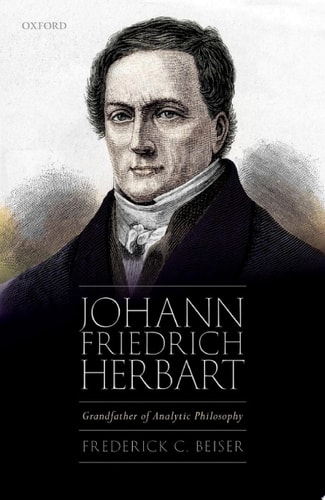
Johann Friedrich Herbart: Grandfather of Analytic Philosophy
0
0
As an Amazon Associate and affiliate partner, Menrva Books earns from qualifying purchases. Learn more
Author Description
Though little known today, Johann Friedrich Herbart was one of the leading philosophers of his age, the competitor of Schelling and Hegel. Although he was trained by Fichte, Herbart soon became a critic of the idealist tradition and developed a philosophy antithetical to it. His own philosophy was opposed to the idealist tradition in important respects: he defended a dualism between the factual and normative; he was an ontological pluralist rather than monist; and he accepted crucial Kantian dualisms that had been rejected by the idealists. Herbart was also an important forerunner of analytic philosophy, first in breaking with the idealist tradition, and second in insisting that the proper method of philosophy is the analysis of concepts rather than speculation about the universe as a whole. In the first intellectual biography of Herbart in English, Frederick C. Beiser studies the development of one of 19th-century Germany's most important philosophers, from his education in Oldenburg and Jena to his final years in Göttingen.
Menrva's Summary
THE THESIS
This work investigates the philosophical contributions of Johann Friedrich Herbart and his role as a critical precursor to the analytic tradition. Prof. Frederick C. Beiser, a scholar of German philosophy, utilizes primary source documents and historical context to reconstruct Herbart's intellectual development. The book argues that Herbart's rejection of German idealism and his emphasis on conceptual analysis establish him as a foundational figure often overlooked in modern philosophical discourse.
THE SCOPE MAP
What You Will Find
- A comprehensive intellectual biography covering Herbart's education in Oldenburg and Jena.
- An analysis of Herbart's opposition to Schelling and Hegel.
- A detailed examination of Herbart's ontological pluralism and his defense of Kantian dualisms.
Scope Limits
- The text focuses primarily on intellectual history rather than a broad social history of the period.
- It does not provide an exhaustive translation of Herbart's complete works.
THE AUTHORITY PERSPECTIVE
Experts recognize this text as the first significant intellectual biography of Herbart in the English language. Scholars frequently note that the prose is accessible while maintaining the academic rigor required for a specialized study of 19th-century German thought.
Page Count:
333
Publication Date:
2021-01-01
Publisher:
OUP Oxford
ISBN-10:
0192666770
ISBN-13:
9780192666772
Philosophy
Biography
Intellectual History
19th Century
Community Tags
Similar Books