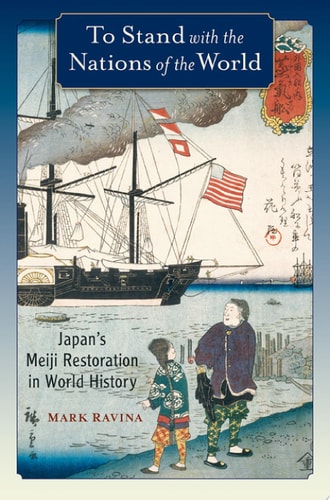
To Stand with the Nations of the World: Japan's Meiji Restoration in World History
0
0
As an Amazon Associate and affiliate partner, Menrva Books earns from qualifying purchases. Learn more
Author Description
The samurai radicals who overthrew the last shogun in 1868 promised to restore ancient and pure Japanese ways. Foreign observers were terrified that Japan would lapse into violent xenophobia. But the new Meiji government took an opposite course. It copied best practices from around the world, building a powerful and modern Japanese nation with the help of European and American advisors. While revering the Japanese past, the Meiji government boldly embraced the foreign and the new. What explains this paradox? How could Japan's 1868 revolution be both modern and traditional, both xenophobic and cosmopolitan?To Stand with the Nations of the World explains the paradox of the Restoration through the forces of globalization. The Meiji Restoration was part of the global "long nineteenth century" during which ambitious nation states like Japan, Britain, Germany, and the United States challenged the world's great multi-ethnic empires--Ottoman, Qing, Romanov, and Hapsburg. Japan's leaders wanted to celebrate Japanese uniqueness, but they also sought international recognition. Rather than simply mimic world powers like Britain, they sought to make Japan distinctly Japanese in the same way that Britain was distinctly British. Rather than sing "God Save the King," they created a Japanese national anthem with lyrics from ancient poetry, but Western-style music. The Restoration also resonated with Japan's ancient past. In the 600s and 700s, Japan was threatened by the Tang dynasty, a dynasty as powerful as the Roman empire. In order to resist the Tang, Japanese leaders borrowed Tang methods, building a centralized Japanese state on Tang models, and learning continental science and technology. As in the 1800s, Japan co-opted international norms while insisting on Japanese distinctiveness. When confronting globalization in 1800s, Japan looked back to that "ancient globalization" of the 600s and 700s. The ancient past was therefore not remote or distant, but immediate and vital.
Menrva's Summary
THE THESIS
This work investigates how the Meiji Restoration functioned as a strategic response to global pressures, reconciling the desire for national uniqueness with the necessity of international integration. Mark Ravina, a professor of history, utilizes a comparative framework to analyze Japan's transformation from a feudal society into a modern nation-state. He argues that the Meiji leaders navigated the nineteenth-century global order by selectively adopting foreign models while simultaneously grounding their legitimacy in ancient Japanese precedents. By framing the Restoration within the context of the 'long nineteenth century,' the author demonstrates that Japan's modernization was not a rejection of tradition, but a calculated synthesis of global norms and local identity.
THE SCOPE MAP
What You Will Find
- Analysis of the geopolitical landscape during the nineteenth century, focusing on the rise of nation-states versus multi-ethnic empires.
- Examination of the historical parallels between the Meiji era and the seventh-century interactions with the Tang dynasty.
- Discussion of cultural and political mechanisms, such as the creation of national anthems and the adoption of Western administrative practices.
Scope Limits
- The text does not provide a comprehensive military history of the Boshin War or the subsequent conflicts of the Meiji period.
- It does not focus on the daily lives of the peasantry or the social history of non-elite classes during the transition.
THE AUTHORITY PERSPECTIVE
Historians and scholars of Japanese studies frequently cite this work for its ability to contextualize the Meiji Restoration within broader global trends rather than viewing it as an isolated national event. Readers often note the clarity of the prose, which makes complex geopolitical arguments accessible to both academic audiences and informed general readers.
Page Count:
328
Publication Date:
2017-01-01
Publisher:
Oxford University Press
ISBN-10:
0190656107
ISBN-13:
9780190656102
History
Japan
Asian Studies
Special Topics
Globalization
Asian History
Community Tags
Similar Books