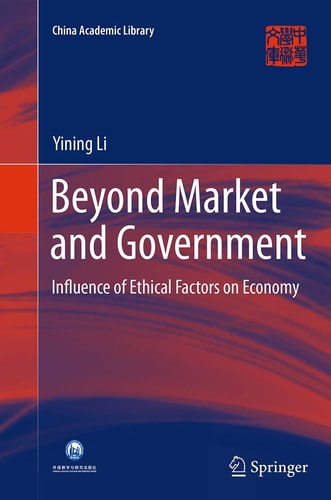
Beyond Market and Government Influence of Ethical Factors on Economy
0
0
As an Amazon Associate and affiliate partner, Menrva Books earns from qualifying purchases. Learn more
Author Description
This book explores how moral factors exert influence on economy from an economic and philosophical point of view. The book takes an in-depth look at topics such as efficiency and coordination, fairness and identification, law and self-discipline and the third distribution, which have long been the focus of public attention. As expounded in this book, in places where regulation by market or government does work, there are still some gaps that the two modes of regulation cannot reach owing to the limitations of their influence. Each does compensate for the other’s limitations, but only up to a point. The gap can only be filled by custom and morality. In this sense, regulation by custom and morality can be viewed as a regulatory mode beyond market and government. In a market economy, market regulation of resource allocation as a basic mode can be called “primary regulation” and government regulation, as a high-level mode, “secondary regulation.” Regulation that relies on the force of custom and morality, a regulation beyond market and government, can be called “the third regulation.” A variety of causes can give rise to market failure or government paralysis, rendering regulation by market or government ineffective or extremely limited. But even in such circumstances, custom and morality still exist and continue working as normal. What affects resource allocation, socio-economic operations and living standards is not just the power of market or government, but that of custom and morality. This book is one of the three published writings that best reflect Professor Li Yining’s academic standpoint. Although written in economic language, the book also incorporates sociology, history and philosophy and will help the reader make better judgment calls in the face of changing market conditions and economic policies.
Menrva's Summary
THE THESIS
This book investigates the limitations of market and government regulation and proposes custom and morality as a crucial 'third regulation' for economic systems. The author, Professor Li Yining, a distinguished economist, argues that while market and government mechanisms are essential for resource allocation, they possess inherent limitations that leave gaps in effective regulation. The book draws upon economics, sociology, history, and philosophy to analyze how custom and morality can fill these regulatory voids, offering a unique perspective on socio-economic operations and living standards. This work is presented as a key reflection of Professor Li's academic stance, aiming to equip readers with a more nuanced understanding for navigating economic complexities.
THE SCOPE MAP
- Analysis of efficiency and coordination in economic systems.
- Exploration of fairness and identification as economic factors.
- Examination of law and self-discipline in economic contexts.
- Discussion of the 'third distribution' and its implications.
- The concept of 'primary regulation' (market) and 'secondary regulation' (government).
- The role of 'the third regulation' (custom and morality) in addressing market failures and government limitations.
- Integration of economic theory with sociological, historical, and philosophical perspectives.
THE AUTHORITY PERSPECTIVE
This book is presented as a significant work reflecting Professor Li Yining's academic viewpoint, intended for readers interested in the intersection of economics, philosophy, and sociology. The text is written in economic language but aims to be accessible to a broader audience seeking to understand the ethical underpinnings of economic systems. Its focus on custom and morality as a regulatory force beyond traditional market and government controls offers a distinct perspective on economic policy and resource allocation. The book is positioned as a valuable resource for making informed judgments amidst evolving economic conditions.
Page Count:
182
Publication Date:
2016-08-23
Publisher:
Springer Berlin Heidelberg
ISBN-10:
3662515083
ISBN-13:
9783662515082
Non-Fiction
Economics
Philosophy
Sociology
Community Tags
Other Editions(3)

Similar Books










Reader Comments
Share Your Thoughts
No comments yet. Be the first to share your thoughts!