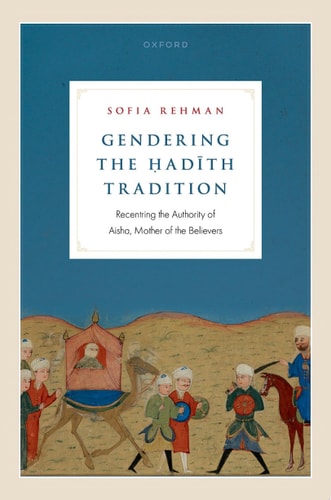
Gendering the Hadith Tradition: Recentering the Authority of Aisha, Mother of the Believers
0
0
As an Amazon Associate and affiliate partner, Menrva Books earns from qualifying purchases. Learn more
Author Description
Gendering the Hadith Tradition presents for the first time a partial translation and study of Imam Badr al-Din al-Zarkashi's work, al-Ijaba li-Iradi ma Istadraktahu Aisha Ala al-Sahabah-The Corrective: Aisha's Rectification of the Companions. It critically analyses from the perspective of hadith criticism a number of sections presenting Aisha's refutations and corrections of key Companions including, Umar b. al-Khattab, Abdullah b. Abbas, Zayd b. Thabit, and Abu Hurayra, applying classical hadith methodology to the scrutiny of narrators by way of impugnment and validation (al-jarh wa al-tadil) in an effort to re-construct and re-present Aisha as a central authority in Islamic knowledge production.This work constitutes a major rethinking of the Muslim hadith and jurisprudential traditions by evaluating how Aisha responded to hadiths that were circulating and being ascribed, often incorrectly, as authoritative statements of the Prophet Muhammad. From her critique of overwhelmingly male Companions of the Prophet, the study elicits a methodology for hadith criticism which is sure to challenge classical approaches. Sofia Rehman unearths the scholarly acumen of this great female Companion and mother of the believers, in her discussion of several legal positions which Aisha held in contradistinction to many of the male authorities among the Companions.This interdisciplinary study serves as a model for how the voice of Aisha may be given renewed life and significance in the way it re-centres her traditions and thinking. A crucial aspect is its contributing to expanding the horizons of multiple Islamic disciplines. A major contribution to the study of hadith lies in the development of an emergent methodology of Aisha in the scrutiny of the actual statements (matn) of traditions, not just the chains of transmission (isnad). The contributions of this study to the development of the Muslim legal tradition (fiqh) also lies in a framework that emerges from this research based on
Menrva's Summary
THE THESIS
This work investigates the scholarly authority of Aisha, Mother of the Believers, by examining her role in correcting and refining the hadith tradition through a critical analysis of Imam Badr al-Din al-Zarkashi's text, al-Ijaba. Sofia Rehman, a scholar of Islamic studies, utilizes classical hadith methodology to evaluate Aisha's refutations of prominent male Companions. The book argues that Aisha's contributions to legal and theological discourse have been historically marginalized and seeks to re-center her as a primary authority in Islamic knowledge production.
THE SCOPE MAP
What You Will Find
- A partial translation and study of al-Ijaba li-Iradi ma Istadraktahu Aisha Ala al-Sahabah.
- Analysis of Aisha's critiques regarding Umar b. al-Khattab, Abdullah b. Abbas, Zayd b. Thabit, and Abu Hurayra.
- A framework for hadith criticism focusing on the content (matn) of traditions rather than solely the chains of transmission (isnad).
- An interdisciplinary approach combining historical analysis, legal theory (fiqh), and gender studies.
Scope Limits
- The study is limited to the specific content found within al-Zarkashi's work and does not provide an exhaustive biography of Aisha.
- It focuses primarily on the hadith and jurisprudential traditions rather than broader socio-political history.
THE AUTHORITY PERSPECTIVE
Scholars and students of Islamic law recognize this text as a significant contribution to the re-evaluation of female authority in early Islamic history. Readers frequently note the academic rigor of the prose and the precision with which the author applies classical methodology to contemporary gender discourse.
Page Count:
240
Publication Date:
2024-01-01
Publisher:
Oxford University Press
ISBN-10:
0192865986
ISBN-13:
9780192865984
History
Religion
Islamic Law
Hadith
Gender Studies
Islam
Hadith Studies
Community Tags
Similar Books