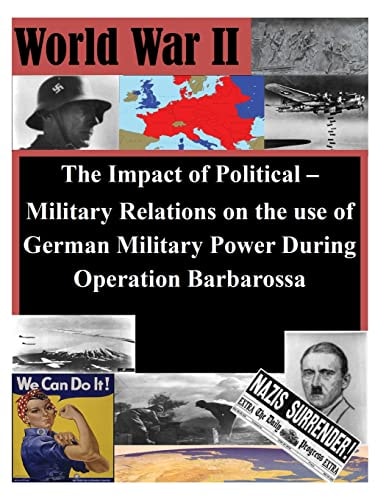
The Impact of Political-Military Relations on the Use of German Military Power
0
0
As an Amazon Associate and affiliate partner, Menrva Books earns from qualifying purchases. Learn more
Author Description
The German General Staff launched Operation Barbarossa in June 1941 assuming the eastern campaign would last only three months. However, within six months after the initiation of hostilities the Red Army blunted the Wehrmacht's attack outside the gates of Moscow, Operation Barbarossa had failed. Although a long standing and professional organization the German General Staff failed to achieve strategic success, despite significant success during the early stages of the campaign. Adolf Hitler's national goal of Russian extermination exceeded the German Army's capabilities. The war lasted nearly four years and resulted in the devastation of western Russia, millions dead and the destruction of Germany. This thesis examines how the divergence between the Wehrmacht's capabilities and Hitler's ideological national objectives affected Operation Barbarossa.Through examination of the historical role the German General Staff held during military operations, this study addresses the linkage between German political and military relations during war. It begins with an analysis of the Prussian General Staff system under Moltke the elder. It follows the staff's development through the wars of German unification, prelude to WW I and, the interwar period leading up to Hitler's rise to power. It concludes with an analysis of Operation Barbarossa and the German General Staff's efforts to achieve strategic victory on the eastern front. Finally it concludes with lessons modern military leaders should learn from the General Staff's mistakes
Menrva's Summary
THE THESIS
This book investigates the critical link between political objectives and military capabilities, specifically examining how the divergence between Adolf Hitler's ideological goals and the German Army's capacity impacted the disastrous Operation Barbarossa. The author, from the U.S. Army Command and General Staff College, analyzes the historical role of the German General Staff, tracing its development from the Prussian system under Moltke the Elder through key periods of German military history, including unification, the lead-up to WWI, the interwar years, and Hitler's rise to power. The core of the study focuses on the strategic failures of Operation Barbarossa, where Hitler's extermination goals exceeded the Wehrmacht's capabilities, leading to a protracted war, immense devastation, and Germany's ultimate defeat. The work concludes by drawing lessons for modern military leaders from these historical mistakes.
THE SCOPE MAP
- Analysis of the Prussian General Staff system under Moltke the Elder.
- Development of the German General Staff through wars of unification and WWI.
- Examination of the interwar period and Hitler's rise to power.
- Detailed analysis of Operation Barbarossa's strategic failures.
- Exploration of the divergence between Hitler's ideological objectives and military capabilities.
- Case study on the impact of political-military relations on German military power.
- Lessons for modern military leaders derived from historical analysis.
THE AUTHORITY PERSPECTIVE
This work is presented as a thesis from the U.S. Army Command and General Staff College, indicating a rigorous academic approach focused on historical analysis and strategic lessons. The subject matter, concerning the critical failures of Operation Barbarossa and the complex relationship between political leadership and military execution, suggests a dense, specialist text aimed at military historians, strategists, and students of World War II. The detailed examination of the German General Staff's evolution and its ultimate shortcomings under Hitler's regime points to a thorough exploration of the causes and consequences of strategic miscalculation.
Page Count:
98
Publication Date:
2014-06-12
Publisher:
CreateSpace Independent Publishing Platform
ISBN-10:
1500162353
ISBN-13:
9781500162351
History
Non-Fiction
Military Strategy
Military History
German history
Community Tags
Similar Books