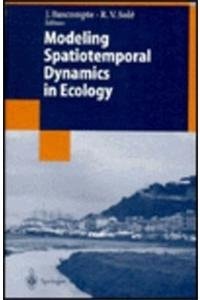
Modeling Spatiotemporal Dynamics in Ecology
0
0
As an Amazon Associate and affiliate partner, Menrva Books earns from qualifying purchases. Learn more
Author Description
Throughout its history, ecology has largely been a descriptive science. Scientists are in need of a theoretical framework that will assist in the understanding of observed patterns, and will serve as a predictive tool. Since ecological systems are dynamic and spatially extended, it is particularly important to understand the processes underlying spatiotemporal patterns.This book reviews one of the newest and most important areas of theoretical ecology: the study of spatiotemporal dynamics by means of a spatially explicit approximation that allows the investigation of the effects of real space.
Menrva's Summary
THE THESIS
This book addresses the critical need for a theoretical framework to understand and predict ecological patterns by focusing on spatiotemporal dynamics. Ecology has historically been a descriptive science, but this work explores the application of spatially explicit approximations to investigate the effects of real space on ecological systems. It reviews one of the newest and most important areas of theoretical ecology, providing tools for understanding dynamic and spatially extended systems. The authors aim to bridge the gap between observation and prediction in ecological research.
THE SCOPE MAP
- Theoretical frameworks for understanding spatiotemporal patterns in ecological systems.
- Methods for applying spatially explicit approximations to ecological modeling.
- Analysis of the effects of real space on ecological processes.
- Review of current research in spatiotemporal dynamics within theoretical ecology.
- Tools for ecologists to move beyond descriptive science towards predictive modeling.
THE AUTHORITY PERSPECTIVE
The book is positioned as a crucial resource for ecologists seeking to develop predictive models for dynamic and spatially extended systems. Its focus on spatiotemporal dynamics and the use of spatially explicit approximations offers a novel approach to understanding observed ecological patterns. The work aims to provide a theoretical foundation for a science that has largely been descriptive, equipping researchers with advanced tools for analysis. It is likely to appeal to academics and advanced students in theoretical ecology and environmental science.
Page Count:
230
Publication Date:
1997-01-01
Publisher:
Springer
ISBN-10:
3540634495
ISBN-13:
9783540634492
Science
Non-Fiction
Mathematical Modeling
Spatial analysis
Ecology
Community Tags
Similar Books