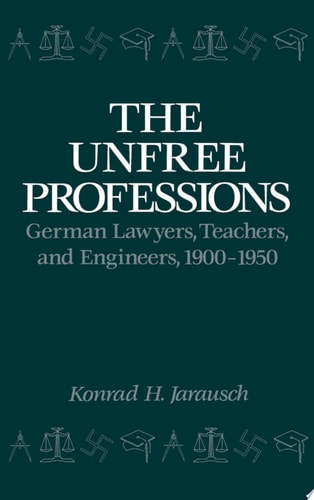
The Unfree Professions: German Lawyers, Teachers, and Engineers, 1900-1950
0
0
As an Amazon Associate and affiliate partner, Menrva Books earns from qualifying purchases. Learn more
Author Description
How could educated professionals have supported the Nazi movement and collaborated with Hitler's inhuman policies? Jarausch examines this fascinating and largely unexplored subject, tracing the social, ideological, and political development of three representative German professions--law, teaching, and engineering--from the late Empire to the early Federal Republic. Based on a reformulated professionalization theory and on authoritative statistics, he describes professional prosperity and prestige in the Second Reich and analyzes the social crisis brought on by hyperinflation, stabilization, and Depression during the chaotic Weimar years. Threatened with the loss of livelihood and frightened by cultural disorientation, many experts embraced neo-conservative ideas and cooperated in Hitler's seizure of power. Welcoming the apparent restoration of their authority in the early Third Reich, professionals collaborated in the racial purges and warping of ethics, practices, and organizations under Nazi rule. During the Second World War, the radicalization of SS terror threatened the very survival of the professions so that most practitioners were only too happy to be rescued by Allied victory. Exploring the reluctant democratization of the post-war professions, Jarausch concludes with a reflection on the lessons of the German experience for the relationship between professionalism and liberty.
Menrva's Summary
THE THESIS
This work investigates how and why educated German professionals—specifically lawyers, teachers, and engineers—supported the Nazi movement and participated in the implementation of its policies between 1900 and 1950. Konrad Hugo Jarausch, a historian specializing in German social and political history, utilizes a reformulated professionalization theory to analyze the intersection of social status, economic instability, and political ideology. By examining the transition from the Second Reich through the Weimar Republic and into the Third Reich, he argues that professional anxiety and a desire for restored authority drove these groups to cooperate with the regime's radical agenda.
THE SCOPE MAP
What You Will Find
- A comparative analysis of three distinct professional groups: law, teaching, and engineering.
- A longitudinal study covering the period from the late German Empire to the early Federal Republic.
- Quantitative data and statistical evidence regarding professional prosperity and social crisis during the Weimar years.
- An exploration of the relationship between professional autonomy and political liberty in twentieth-century Germany.
THE AUTHORITY PERSPECTIVE
Historians and sociologists frequently cite this text as a foundational study on the complicity of the German middle class and professional elite during the Nazi era. Scholars note the rigor of Jarausch's methodology in applying professionalization theory to historical political behavior.
Page Count:
368
Publication Date:
1990-09-06
Publisher:
Oxford University Press
ISBN-10:
0195044827
ISBN-13:
9780195044829
History
Sociology
German history
Professionalism
Nazi Germany
Community Tags
Similar Books