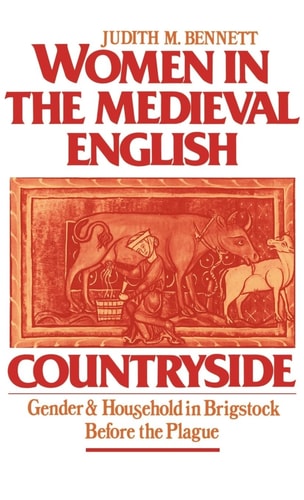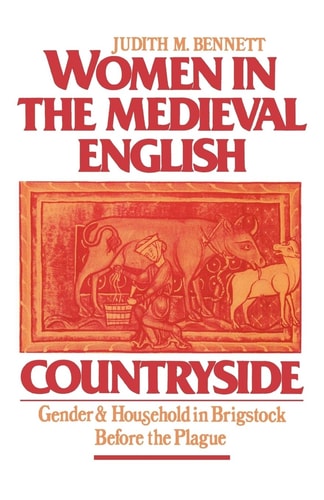
Women in the Medieval English Countryside: Gender and Household in Brigstock Before the Plague
0
0
As an Amazon Associate and affiliate partner, Menrva Books earns from qualifying purchases. Learn more
Author Description
Unlike most histories of European women, which have typically focused on the 19th and 20th century elite, this study reconstructs the public lives of peasant women and men during the six decades before the Black Death of 1348-49. Drawing on the extensive records of the forest manor of Brigstock, Judith Bennett challenges the myth of a "golden age" of equality for medieval men and women. Instead, she ably shows that women faced profound political, legal, economic, and social disadvantages in their dealings with men. These disadvantages stemmed more from women's household status as dependents of their husbands than from any notion of female inferiority; consequently, adolescents and widows participated much more actively than wives in the public life of Brigstock. Women in the Medieval English Countryside demonstrates not only how enduring the subordination of women has been throughout English history, but also how firmly that subordination has been rooted in the conjugal household.
Menrva's Summary
THE THESIS
This study investigates the extent of gender equality in the medieval English peasantry by examining the public lives of men and women in the manor of Brigstock prior to the Black Death. Judith M. Bennett, a scholar of medieval social history, utilizes extensive manorial records to challenge the historical myth of a 'golden age' for women. By analyzing legal, economic, and social data, she argues that women's subordination was fundamentally rooted in their status as dependents within the conjugal household rather than inherent notions of inferiority.
THE SCOPE MAP
What You Will Find
- Detailed analysis of manorial court records from the forest manor of Brigstock.
- A comparative study of public participation between wives, widows, and adolescents.
- Examination of legal and economic constraints placed upon peasant women in the early 14th century.
- A structural argument linking gender inequality to the organization of the medieval household.
THE AUTHORITY PERSPECTIVE
Historians and scholars of medieval social structures frequently cite this work as a foundational text for understanding the intersection of gender and household economics. Readers often note the rigorous use of primary source records to dismantle long-standing historiographical assumptions about the medieval period.
Page Count:
338
Publication Date:
1989-09-28
Publisher:
Oxford University Press
ISBN-10:
0195045610
ISBN-13:
9780195045611
History
Great Britain
Social History
Women
Gender Studies