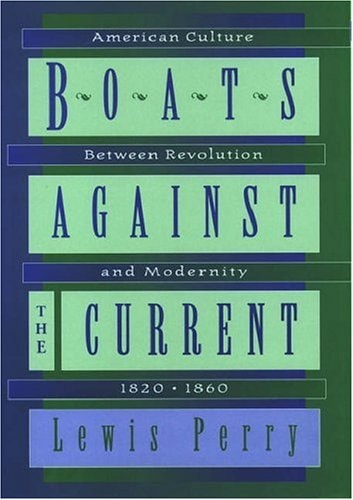
Boats Against the Current: American Culture Between Revolution and Modernity, 1820-1860
0
0
As an Amazon Associate and affiliate partner, Menrva Books earns from qualifying purchases. Learn more
Author Description
As editor of the Journal of American History, author of a number of books on nineteenth-century America, and professor of history at Vanderbilt University, Lewis Perry has been a leading historian of United States intellectual life for more than two decades. Now, in this highly original look at American culture in the decades between the War of 1812 and the Civil War, he paints a vivid portrait of our tumultuous society as it veered toward modernity.Boats Against the Current provides a fascinating account of how American culture emerged from the sheltered, elitist world of the eighteenth century into the dynamic, turbulent civilization that reached full bloom after the Civil War. The antebellum years were times of flux and change, years of a society rushing into the western wilds, muscular and ambitious, yet haunted by uncertainty about its future and its past. Perry begins with a fresh look at Andrew Jackson--who personally linked the revolutionary period to the era that bears his name--vividly recreating a time when Americans, feeling their ties to the past disintegrating, fostered a new fascination with history. Then Perry introduces us to the observations of such articulate foreign travelers as Alexis de Tocqueville and Fredrika Bremer. He deftly weaves together these writers' perspectives to provide a fascinating look at our emergent nation. Here, too, are the women of the cities and frontier, the peddlers, preachers, and showmen, along with such writers as Hawthorne, Emerson, Whittier, and Parker. Perry brings these personalities and writings together to show us how early nineteenth century America saw itself, in both its promise and its fears.Gracefully written and filled with fresh insights, Boats Against the Current offers a brilliant portrait of a society in the midst of change, expansion, and reflection about its own future and past. Written by one of our leading intellectual historians, it makes a major contribution to our understanding of the emergence
Menrva's Summary
THE THESIS
How did the United States navigate the transition from an elitist, post-revolutionary society to a dynamic, modern civilization between 1820 and 1860? Lewis Perry, a distinguished professor of history and former editor of the Journal of American History, utilizes this work to examine the intellectual and cultural anxieties of the antebellum era. He argues that this period was defined by a profound tension between rapid westward expansion and a pervasive uncertainty regarding the nation's identity and historical continuity. By synthesizing primary accounts from foreign observers and domestic figures, Perry constructs a framework that illustrates the emergence of a uniquely American consciousness.
THE SCOPE MAP
What You Will Find
- Analysis of the cultural shift from the 18th-century revolutionary legacy to the onset of the Civil War.
- Examination of the Jacksonian era as a bridge between traditional governance and modern democratic turbulence.
- Integration of primary source observations from foreign travelers such as Alexis de Tocqueville and Fredrika Bremer.
- Exploration of diverse social strata, including frontier settlers, urban women, preachers, and prominent literary figures like Emerson and Hawthorne.
THE AUTHORITY PERSPECTIVE
Historians and scholars of American intellectual life recognize this work as a significant contribution to the study of antebellum cultural development. Readers frequently note that Perry provides a sophisticated, well-researched synthesis that effectively captures the complexities of a society in flux.
Page Count:
352
Publication Date:
1993-04-15
Publisher:
Oxford University Press
ISBN-10:
0195060911
ISBN-13:
9780195060911
History
19th Century
Intellectual History
American History
Community Tags
Similar Books