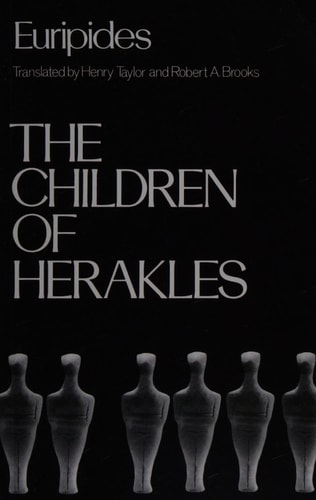
The Children of Herakles
0
0
As an Amazon Associate and affiliate partner, Menrva Books earns from qualifying purchases. Learn more
Author Description
One of the shortest plays in Greek drama, The Children of Herakles offers enough action for two or three plays of normal length. But this very richness and complexity have made the play elusive, subject to dismissive readings, and extraordinarily difficult to translate; in consequence, it has suffered from neglect over the ages. This vibrant new translation makes clear that The Children of Herakles is actually a wonderfully well-crafted work of art, a play offering a wealth of rewards to the modern reader.It is a play about war and the effects of war within the state. Herakles, the legendary hero cursed from birth, was never permitted a triumphant homecoming. Here, his descendants continue the effort to return home, seeking asylum from the persecution of the king who had imposed on Herakles the famous twelve labors. While it pursues concepts of deep moral grandeur, it ends with a denouement of astonishing physical and ethical brutality, and affords Euripides a severe comment on what he believed was the decline of the Athenian character.
Menrva's Summary
THE PULSE
The descendants of Herakles seek sanctuary in Athens, triggering a high-stakes political and military confrontation with the encroaching forces of Eurystheus. Driven by the need for protection against the relentless persecution of King Eurystheus, the children of the deceased hero Herakles arrive in Athens to plead for asylum. They are supported by Iolaus, an aging companion of Herakles, and Demophon, the Athenian king, who must weigh the moral obligation of hospitality against the threat of total war. The narrative unfolds through a series of intense dialogues and choral interventions, characteristic of the classical Greek tragic form. The play examines the tension between civic duty and the brutal realities of power, ultimately questioning the moral integrity of the state during times of conflict.
INSIDE THE PAGES
- Utilization of the traditional Greek chorus to provide commentary and thematic depth.
- Exploration of the political consequences of granting asylum to refugees.
- Dramatic tension centered on the sacrifice required to secure military victory.
- Examination of the decline of Athenian civic character and moral standards.
- Contrast between the vulnerability of the suppliants and the arrogance of the aggressor.
- Use of formal, elevated language typical of Euripidean tragedy.
- Focus on the legacy of Herakles as a catalyst for the plot's central conflict.
- A stark, violent denouement that challenges the audience's expectations of heroic resolution.
THE COLLECTIVE ECHO
Discussion often centers on the play's unusual pacing and its dense, action-oriented structure which distinguishes it from other works by Euripides. Readers frequently highlight the stark contrast between the initial focus on moral duty and the abrupt, brutal conclusion that defines the final act. Critics often analyze the work as a pointed critique of Athenian political behavior during the Peloponnesian War. The play is frequently studied for its complex portrayal of the relationship between the state and the vulnerable, making it a significant text for those interested in the evolution of classical drama. Many readers find the characterization of the suppliants to be a compelling study in desperation and resilience.
Page Count:
112
Publication Date:
1992-01-30
Publisher:
Oxford University Press
ISBN-10:
019507288X
ISBN-13:
9780195072884
Drama
Plays
Greek Tragedy
Mythology
Classical
English drama
Dramatic works
Community Tags
Similar Books