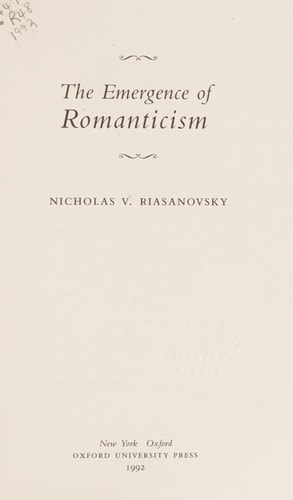
The Emergence of Romanticism
0
0
As an Amazon Associate and affiliate partner, Menrva Books earns from qualifying purchases. Learn more
Author Description
Although primarily known as an eminent historian of Russia, Nicholas Riasanovsky has been a longtime student of European Romanticism. In this book, Riasanovsky offers a refreshing and appealing new interpretation of Romanticism's goals and influence. He searches for the origins of the dazzling vision that made the great early Romantic poets in England and Germany--Wordsworth, Coleridge, Novalis, and Friedrich Schlegel--look at the world in a new way. He stresses that Romanticism was produced only by Western Christian civilization, with its unique view of humankind's relationship to God. The Romantic's frantic and heroic striving after unreachable goals mirrors Christian beliefs in human inability to adequately address God, speak to God, or praise God. Further, Riasanovsky argues that Romantic thought had important political implications, playing a key role in the rise of nationalism in Europe. Offering a historical examination of an area often limited to literary analysis, this book gracefully makes a larger historical statement about the nature and centrality of European Romanticism.
Menrva's Summary
THE THESIS
This book investigates the origins and historical significance of European Romanticism by examining its deep-seated connection to Western Christian civilization. Nicholas V. Riasanovsky, a distinguished historian of Russia, utilizes his extensive background in European intellectual history to challenge conventional literary interpretations. He argues that the Romantic movement was not merely an aesthetic shift but a profound reflection of the Christian understanding of the human relationship with the divine. By analyzing the works of early English and German poets, he posits that the movement's inherent striving for the unreachable is rooted in theological constraints.
THE SCOPE MAP
What You Will Find
- Historical analysis of the emergence of Romanticism in England and Germany.
- Examination of the theological foundations of Romantic thought.
- Exploration of the political implications of Romanticism, specifically regarding the rise of European nationalism.
- Comparative study of major figures including Wordsworth, Coleridge, Novalis, and Friedrich Schlegel.
THE AUTHORITY PERSPECTIVE
Scholars and historians frequently commend this work for bridging the gap between literary analysis and broader historical inquiry. Experts highlight the text as a valuable contribution to understanding how intellectual movements shape political and social structures in Western history.
Page Count:
128
Publication Date:
1992-10-29
Publisher:
Oxford University Press
ISBN-10:
019507341X
ISBN-13:
9780195073416
History
Philosophy
Christianity and literature
Literary Criticism
European History
English literature
Romanticism
Community Tags
Other Editions(2)

Similar Books