Imperialism: A History in Documents
0
0
As an Amazon Associate and affiliate partner, Menrva Books earns from qualifying purchases. Learn more
Author Description
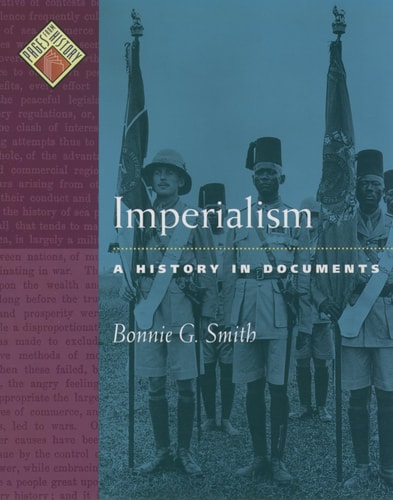
We talk about living in a global era, but the groundwork for it was laid more than a century ago. By the late 19th century, Europe, Japan, and the United States had taken control of most of the world. Travel and trade between home countries and colonies sent goods and technology to even the most remote corners of the globe. An English lady's letter home on smallpox inoculations in Turkey, an American missionary's account of the forcible collection of rubber in Belgian Congo, and a Chinese official's regulations for European merchants are among the primary sources that Bonnie Smith has assembled to demonstrate the advantages and drawbacks of the new economy. Society, education, and the environment also underwent massive changes, as witnessed by the selection of excerpts from an exam in a German missionary school in Togo and British reports on the devastation of entire forests in Burma.Imperial growth did not come without a price. A Japanese document outlining governance in Korea and U.S. President Benjamin Harrison's defense of the annexation of Hawaii illustrate the militant nationalism, religious intolerance, and pseudo-scientific racist theories used to justify the brute force of colonial rule. The colonized nations fought back-a popular Chinese poem in praise of the Boxers' opposition to foreign rule attests to this rebellious spirit, and a Moroccan's shock at "barbaric" European mores illustrates the conquered's view of the conquerors. A picture essay, "Mixture," showcases the amalgamation of global cultures through photographs of buildings, furniture, advertisements, sporting events, and sculpture. Bonnie Smith vividly captures the booming expansion of a flawed political system and expertly links the documentary evidence with informed commentary and prefatory essays to each chapter.
Menrva's Summary
THE THESIS
This work investigates the complex socio-political and economic mechanisms of global imperialism during the late 19th and early 20th centuries through the lens of primary source documentation. Bonnie G. Smith, a distinguished historian, curates a diverse collection of archival materials to illustrate how European, American, and Japanese powers established global hegemony. By juxtaposing official government records with personal accounts from both colonizers and the colonized, the author constructs a multifaceted argument regarding the systemic advantages and devastating human costs of colonial expansion. The text serves as a critical examination of how nationalism, economic exploitation, and cultural imposition reshaped the modern world.
THE SCOPE MAP
What You Will Find
- A comprehensive collection of primary source documents including letters, government regulations, missionary accounts, and poetry.
- Analysis of the environmental, social, and educational impacts of colonial rule in regions such as the Belgian Congo, Korea, and Burma.
- A visual essay titled "Mixture" that documents the cultural amalgamation resulting from global trade and occupation.
- Contextual commentary and prefatory essays that bridge the gap between historical evidence and modern geopolitical understanding.
THE AUTHORITY PERSPECTIVE
Scholars and educators frequently cite this volume as a highly effective pedagogical tool for introducing students to the nuances of colonial history through direct engagement with archival texts. The inclusion of diverse perspectives from the colonized population is widely praised for providing a balanced and critical view of imperialist agendas.
Page Count:
176
Publication Date:
2000-11-09
Publisher:
Oxford University Press
ISBN-10:
0195108019
ISBN-13:
9780195108019
History
Social History
Imperialism
World history
Colonialism
Community Tags
Other Editions(2)
Similar Books