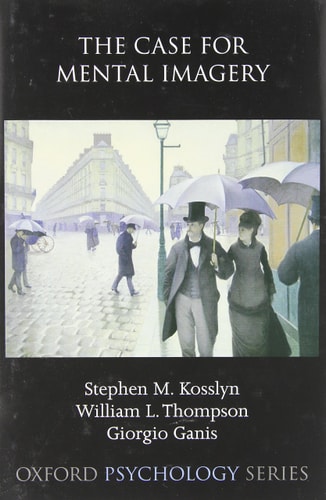
The Case for Mental Imagery
0
0
As an Amazon Associate and affiliate partner, Menrva Books earns from qualifying purchases. Learn more
Author Description
When we try to remember whether we left a window open or closed, do we actually see the window in our mind? If we do, does this mental image play a role in how we think? For almost a century, scientists have debated whether mental images play a functional role in cognition. In The Case for Mental Imagery, Stephen Kosslyn, William Thompson, and Giorgio Ganis present a complete and unified argument that mental images do depict information, and that these depictions do play a functional role in human cognition. They outline a specific theory of how depictive representations are used in information processing, and show how these representations arise from neural processes. To support this theory, they seamlessly weave together conceptual analyses and the many varied empirical findings from cognitive psychology and neuroscience. In doing so, they present the conceptual grounds for positing this type of internal representation and summarize and refute arguments to the contrary. Their argument also serves as a historical review of the imagery debate from its earliest inception to its most recent phases, and provides ample evidence that significant progress has been made in our understanding of mental imagery. In illustrating how scientists think about one of the most difficult problems in psychology and neuroscience, this book goes beyond the debate to explore the nature of cognition and to draw out implications for the study of consciousness. Student and professional researchers in vision science, cognitive psychology, philosophy, and neuroscience will find The Case for Mental Imagery to be an invaluable resource for understanding not only the imagery debate, but also and more broadly, the nature of thought, and how theory and research shape the evolution of scientific debates.
Menrva's Summary
THE THESIS
This book investigates whether mental imagery functions as a depictive representation that plays an active, necessary role in human cognition. The authors, prominent researchers in cognitive psychology and neuroscience, synthesize decades of empirical data to argue that mental images are not merely epiphenomenal byproducts of thought. They propose a unified theoretical framework that links cognitive processing to specific neural mechanisms, providing a rigorous defense of the functional status of imagery against historical skepticism.
THE SCOPE MAP
What You Will Find
- A comprehensive historical review of the imagery debate in psychology and neuroscience.
- A detailed theoretical model explaining how depictive representations are processed in the brain.
- Empirical evidence drawn from cognitive psychology experiments and neuroimaging studies.
- A critical analysis and refutation of opposing arguments regarding the nature of mental representations.
THE AUTHORITY PERSPECTIVE
Experts recognize this work as a definitive synthesis of the imagery debate, frequently citing it for its clear articulation of complex cognitive theories. Researchers and students in the field value the text for its balanced integration of philosophical inquiry and hard neuroscientific data.
Page Count:
260
Publication Date:
2006-03-09
Publisher:
Oxford University Press
ISBN-10:
0195179080
ISBN-13:
9780195179088
Psychology
Science
Philosophy
Neuroscience
Community Tags
Other Editions(2)
Similar Books












Reader Comments
Share Your Thoughts
No comments yet. Be the first to share your thoughts!