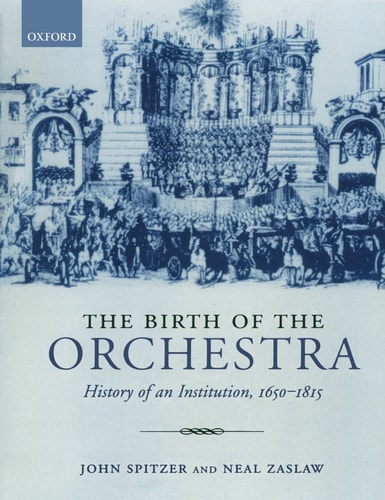
The Birth of the Orchestra: History of an Institution 1650-1815
0
0
As an Amazon Associate and affiliate partner, Menrva Books earns from qualifying purchases. Learn more
Author Description
This is the story of the orchestra, from 16th-century string bands to the "classical" orchestra of Haydn, Mozart, and Beethoven. Spitzer and Zaslaw document orchestral organization, instrumentation, social roles, repertories, and performance practices in Europe and the American colonies, concluding around 1800 with the widespread awareness of the orchestra as a central institution in European life.
Menrva's Summary
THE THESIS
This work investigates the origins and evolution of the orchestra as a foundational social and musical institution between 1650 and 1815. John Spitzer and Neal Zaslaw, both distinguished musicologists, utilize extensive archival research and historical performance data to trace the transition from small, informal string bands to the standardized, large-scale ensembles associated with the works of Haydn, Mozart, and Beethoven. The authors argue that the orchestra emerged not merely as a collection of instruments, but as a complex social organization shaped by the cultural and political demands of European and colonial societies.
THE SCOPE MAP
What You Will Find
- Detailed documentation of orchestral instrumentation and ensemble size across the 17th and 18th centuries.
- Analysis of the social roles and professional status of musicians within the orchestral hierarchy.
- Examination of performance practices and repertories in both European centers and the American colonies.
- A comprehensive study of the institutionalization of the orchestra as a central pillar of Western musical life.
THE AUTHORITY PERSPECTIVE
Musicologists and historians frequently cite this text as a definitive reference for the development of the modern orchestra. Experts highlight the rigorous archival methodology and the clarity with which the authors connect technical musical changes to broader societal shifts.
Page Count:
614
Publication Date:
2005-09-01
Publisher:
Oxford University Press
ISBN-10:
0195189558
ISBN-13:
9780195189551
Music
History
Criticism history
Musicology
Community Tags
Similar Books