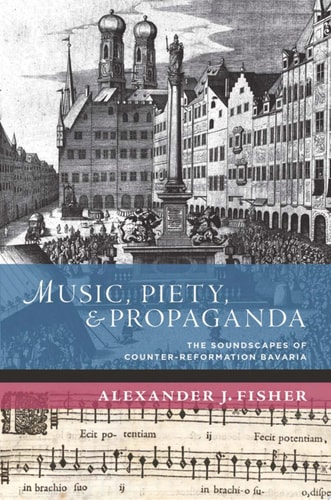
Music, Piety, and Propaganda: The Soundscapes of Counter-Reformation Bavaria
0
0
As an Amazon Associate and affiliate partner, Menrva Books earns from qualifying purchases. Learn more
Author Description
Music, Piety, and Propaganda: The Soundscapes of Counter-Reformation Bavaria explores the nature of sound as a powerful yet ambivalent force in the religious struggles that permeated Germany during the Counter-Reformation. Author Alexander J. Fisher goes beyond a musicological treatment of composers, styles, and genres to examine how music, and more broadly sound itself, shaped the aural landscape of Bavaria as the duchy emerged as a militant Catholic bulwark. Fisher focuses particularly on the ways in which sound--including bell-ringing, gunfire, and popular song, as well as cultivated polyphony--not only was deployed by Catholic secular and clerical elites to shape the religious identities of Bavarian subjects, but also carried the potential to challenge and undermine confessional boundaries. Surviving literature, archival documents, and music illustrate the ways in which Bavarian authorities and their allies in the Catholic clergy and orders deployed sound to underline crucial theological differences with their Protestant antagonists, notably the cults of the Virgin Mary, the Eucharist, and the saints. Official and popular rituals like divine worship, processions, and pilgrimages all featured distinctive sounds and music that shaped and reflected an emerging Catholic identity. Although officials imposed a severe regime of religious surveillance, the Catholic state's dominance of the soundscape was hardly assured. Fisher traces archival sources that show the resilience of Protestant vernacular song in Bavaria, the dissemination and performance of forbidden, anti-Catholic songs, the presence of Lutheran chorales in nominally Catholic church services into the late 16th century, and the persistence of popular "noise" more generally. Music, Piety, and Propaganda thus reveals historical, theological, and cultural issues of the period through the piercing dimension of its sounds, bringing into focus the import of sound as a strategic cultural tool with significant impac
Menrva's Summary
THE THESIS
How did the strategic deployment of sound and music function as a tool of religious identity and political control in Counter-Reformation Bavaria? Alexander J. Fisher, a scholar of music history, investigates the intersection of theology, statecraft, and auditory culture in early modern Germany. By analyzing archival documents, liturgical records, and surviving musical scores, Fisher argues that sound served as both a mechanism for Catholic indoctrination and a site of resistance for Protestant influence. The book establishes a framework where the sonic environment—ranging from polyphonic compositions to the ringing of bells—acted as a primary medium for shaping the confessional landscape of the Bavarian duchy.
THE SCOPE MAP
What You Will Find
- Analysis of the Bavarian soundscape during the late 16th and early 17th centuries.
- Examination of how Catholic elites utilized music, gunfire, and bell-ringing to reinforce theological boundaries.
- Evidence of Protestant vernacular song and Lutheran chorales persisting within Catholic territories.
- Investigation into the role of public rituals, pilgrimages, and processions in constructing religious identity.
THE AUTHORITY PERSPECTIVE
Scholars and music historians frequently cite this work as a significant contribution to the study of soundscapes in early modern Europe. Readers often note the academic density of the prose, which provides a rigorous examination of how auditory culture functioned within the political and religious conflicts of the Counter-Reformation.
Page Count:
384
Publication Date:
2013-01-01
Publisher:
Oxford University Press
ISBN-10:
0199311358
ISBN-13:
9780199311354
Religion
History
European History
Musicology
Humanities
Cultural History
Music History
Religious History
Criticism history
Community Tags
Other Editions(2)

Similar Books












Reader Comments
Share Your Thoughts
No comments yet. Be the first to share your thoughts!