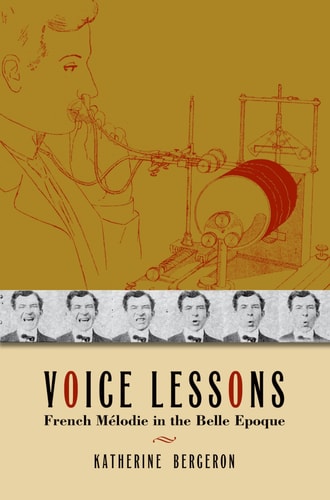
Voice Lessons: French Mélodie in the Belle Epoque
0
0
As an Amazon Associate and affiliate partner, Menrva Books earns from qualifying purchases. Learn more
Author Description
Language, education, science, and song come together in surprising ways in Katherine Bergeron's new history of music in the Belle Epoque. Voice Lessons examines the modern musical art known as la mélodie française and its rise to prominence in the years around 1900-a period when France was pouring resources into national literacy and French scholars were beginning to grasp the nuances of the spoken tongue. Bergeron explores the relationship between the free, secular, and compulsory school system of the Third Republic, and the experimental sciences of language that grew alongside it, to observe the ways in which both science and school redefined the verbal arts in France at century's end.The music of Fauré, Debussy, and Ravel; the writings of Mallarmé, Rimbaud, and Verlaine; the performances of Maggie Teyte, Reynaldo Hahn, and Sarah Bernhardt; the linguistic studies of Paul Passy and Abbé Rousselot: all these sources offer evidence of the new ideas of expression that proliferated during one of the most idealistic moments in French musical history, when poets, composers, actors, singers, and scientists all learned to imagine-and to speak-their language in new ways. Through close readings of songs, poems, sound recordings, and other historical records, Voice Lessons narrates the development of a rare musical art, seeking to explain why this art emerged, why it mattered, and why it eventually disappeared.
Menrva's Summary
THE THESIS
This book investigates how the intersection of national education, linguistic science, and artistic expression fostered the rise and eventual decline of the French mélodie during the Belle Epoque. Katherine Bergeron, a scholar of music history, utilizes a multidisciplinary approach to analyze the Third Republic's focus on literacy alongside the experimental phonetic sciences of the era. By examining the works of composers like Debussy and Fauré alongside the linguistic theories of the time, she argues that the definition of the verbal arts was fundamentally transformed by the period's unique socio-political climate.
THE SCOPE MAP
What You Will Find
- Historical analysis of the French Third Republic's educational reforms and their impact on national language.
- Examination of the relationship between phonetic science and musical composition at the turn of the 20th century.
- Close readings of primary source materials including musical scores, poetry by Mallarmé and Verlaine, and early sound recordings.
- A study of the cultural shift in performance practices involving figures such as Sarah Bernhardt and Reynaldo Hahn.
THE AUTHORITY PERSPECTIVE
Scholars and musicologists frequently cite this work for its innovative synthesis of linguistic theory and music history. The text is recognized for its academic rigor and its ability to contextualize the French mélodie within the broader intellectual currents of the Belle Epoque.
Page Count:
424
Publication Date:
2010-01-20
Publisher:
Oxford University Press
ISBN-10:
0195337050
ISBN-13:
9780195337051
Music
History
Criticism history
French History
Humanities
Cultural History
Linguistics
Music History
Musicology
Songs French
Singing
Community Tags
Similar Books