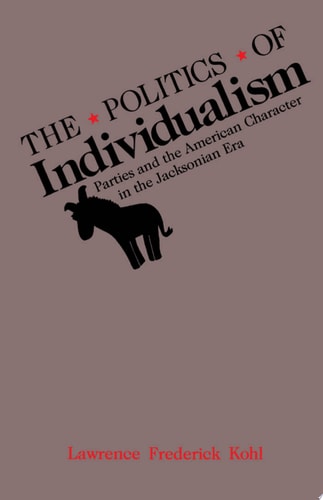
The Politics of Individualism: Parties and the American Character in the Jacksonian Era
0
0
As an Amazon Associate and affiliate partner, Menrva Books earns from qualifying purchases. Learn more
Author Description
In the fifty years following the Revolution, America's population nearly quadrupled, its boundaries expanded, industrialization took root in the Northeast, new modes of transportation flourished, state banks proliferated and offered easy credit to eager entrepreneurs, and Americans found themselves in the midst of an accelerating age of individualism, equality, and self-reliance. To the Jacksonian generation, it seemed as if their world had changed practically overnight. The Politics of Individualism looks at the political manifestations of these staggering social transformations. During the 1830s and 1840s, Americans were consumed by politics and party loyalties were fierce. Here, Kohl draws on the political rhetoric found in speeches, newspapers, periodicals, and pamphlets to place the Democrats and the Whigs in a solid social and psychological context. He contends that the political division between these two parties reflected the division between Americans unsettled by the new individualistic social order and those whose character allowed them to strive more confidently within it. Democrats, says Kohl, were more "tradition-directed," bound to others in more personal ways; Whigs, on the other hand, were more "inner-directed" and embraced the impersonal, self-interested relationships of a market society. By examining this fascinating dialogue of parties, Kohl brings us bright new insight into the politics and people of Jacksonian America.
Menrva's Summary
THE THESIS
This book investigates how the rapid social and economic transformations of the early 19th century shaped the ideological divide between the Democratic and Whig parties in America. Lawrence Frederick Kohl, a historian specializing in the Jacksonian era, utilizes a vast array of primary source materials—including political speeches, newspapers, and pamphlets—to construct his argument. He posits that the political polarization of the 1830s and 1840s was not merely about policy, but was a fundamental reflection of how different segments of the American population psychologically adapted to the rise of individualism and market capitalism. By contrasting the 'tradition-directed' Democrats with the 'inner-directed' Whigs, Kohl provides a framework for understanding the internal tensions of a nation in flux.
THE SCOPE MAP
What You Will Find
- Analysis of the socio-economic shifts in the United States between the 1780s and 1840s.
- A comparative psychological framework distinguishing between tradition-directed and inner-directed character types.
- Extensive examination of political rhetoric found in contemporary newspapers, periodicals, and pamphlets.
- An exploration of how market expansion and industrialization influenced individual identity and party affiliation.
THE AUTHORITY PERSPECTIVE
Historians and scholars of the Jacksonian period frequently cite this work for its innovative application of social psychology to political history. It is widely regarded as a significant contribution to the understanding of how early American political identity was inextricably linked to the broader cultural transition toward a modern market society.
Page Count:
288
Publication Date:
1991-01-01
Publisher:
Oxford University Press USA
ISBN-10:
0195361830
ISBN-13:
9780195361834
History
19th Century
American History
Community Tags
Similar Books