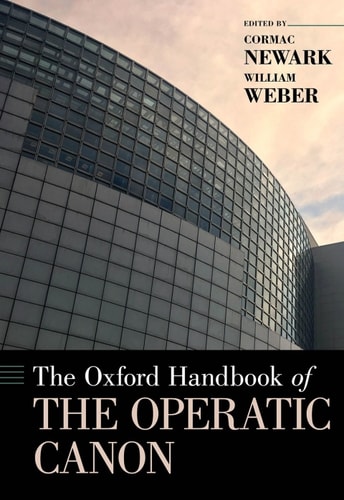
The Oxford Handbook of the Operatic Canon (Oxford Handbooks)
0
0
As an Amazon Associate and affiliate partner, Menrva Books earns from qualifying purchases. Learn more
Author Description
Opera has always been a vital and complex mixture of commercial and aesthetic concerns, of bourgeois politics and elite privilege. In its long heyday in the eighteenth and nineteenth centuries, it came to occupy a special place not only among the arts but in urban planning, too this is, perhaps surprisingly, often still the case. The Oxford Handbook of the Operatic Canon examines how opera has become the concrete edifice it was never meant to be, by tracing its evolution from a market entirely driven by novelty to one of the most canonic art forms still in existence.Throughout the book, a lively assembly of musicologists, historians, and industry professionals tackle key questions of opera's past, present, and future. Why did its canon evolve so differently from that of concert music? Why do its top ten titles, all more than a century old, now account for nearly a quarter of all performances worldwide? Why is this system of production becoming still more top-heavy, even while the repertory seemingly expands, notably to include early music?Topics range from the seventeenth century to the present day, from Russia to England and continental Europe to the Americas. To reflect the contested nature of many of them, each is addressed in paired chapters. These complement each other in different ways: by treating the same geographical location in different periods, by providing different national or regional perspectives on the same period, or by thinking through similar conceptual issues in contrasting or changing contexts. Posing its questions in fresh, provocative terms, The Oxford Handbook of the Operatic Canon challenges scholarly assumptions in music and cultural history, and reinvigorates the dialogue with an industry that is, despite everything, still growing.
Menrva's Summary
THE THESIS
This volume investigates the historical and economic mechanisms that transformed opera from a market driven by ephemeral novelty into a rigid, top-heavy canon of enduring works. Editors Cormac Newark and William V. Weber curate a collection of essays from musicologists and industry professionals to analyze why opera's repertory remains dominated by a small selection of century-old titles. The text employs a comparative framework, utilizing paired chapters to contrast geographical, temporal, and conceptual perspectives on the operatic industry.
THE SCOPE MAP
What You Will Find
- Historical analysis of operatic production from the seventeenth century to the present day.
- Comparative studies of regional operatic markets across Russia, England, Europe, and the Americas.
- Examination of the tension between commercial interests and aesthetic values in urban cultural planning.
- Methodological inquiry into the divergence between the operatic canon and the concert music canon.
THE AUTHORITY PERSPECTIVE
Experts recognize this handbook as a significant contribution to musicology that challenges traditional scholarly assumptions regarding the stability of the operatic repertory. Readers frequently note the academic density of the prose and the utility of the paired-chapter structure for understanding complex cultural shifts.
Page Count:
638
Publication Date:
2020-01-01
Publisher:
Oxford University Press
ISBN-10:
0197510558
ISBN-13:
9780197510551
Music
History
Musicology
Humanities
Criticism history
Music History
Opera
Community Tags
Similar Books