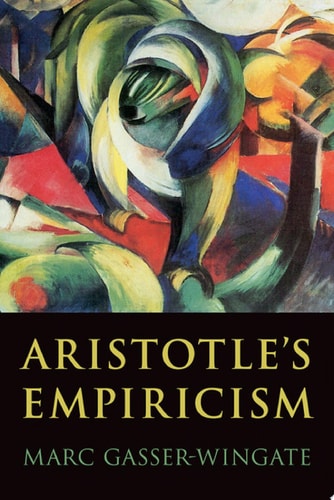
Aristotle's Empiricism
0
0
As an Amazon Associate and affiliate partner, Menrva Books earns from qualifying purchases. Learn more
Author Description
Aristotle is famous for thinking that all our knowledge comes from perception. But it's not immediately clear what this view is meant to entail. It's not clear, for instance, what perception is supposed to contribute to the more advanced forms of knowledge that derive from it. Nor is it clear how we should understand the nature of its contribution—what it might mean to say that these more advanced forms of knowledge are "derived from" or "based on" what we perceive. Aristotle is often thought to have disappointingly little to say on these matters. Gasser-Wingate makes the case that this thought is mistaken: a coherent and philosophically attractive view of perceptual knowledge can be found in the various texts in which Aristotle discusses perception's role in animal life, the cognitive resources on which it does and does not depend, and the relation it bears to practical and theoretical modes of understanding. Aristotle's Empiricism offers a sustained examination of these discussions and their epistemological, psychological, and ethical implications. It defends an interpretation of Aristotle as a moderate sort of empiricist, who thinks we can develop sophisticated forms of knowledge by broadly perceptual means—and that we therefore share an important part of our cognitive lives with nonrational animals—but also holds that our intellectual powers allow us to surpass these animals in certain ways and thereby develop distinctively human forms of understanding.
Menrva's Summary
THE THESIS
This book investigates the core question of how Aristotle’s empiricism functions as a coherent epistemological framework rather than a collection of disparate observations. Marc Gasser-Wingate, a scholar of ancient philosophy, utilizes a rigorous analysis of Aristotle’s primary texts to challenge the common academic assumption that the philosopher lacked a structured theory of perceptual knowledge. By examining the intersection of animal cognition, practical wisdom, and theoretical understanding, the author argues that Aristotle presents a sophisticated, moderate empiricism that bridges the gap between sensory experience and human intellectual achievement.
THE SCOPE MAP
What You Will Find
- An analysis of the cognitive resources required for perception in both rational and nonrational animals.
- A framework for understanding the transition from basic sensory input to advanced theoretical knowledge.
- A synthesis of epistemological, psychological, and ethical implications found within Aristotelian texts.
- A defense of the view that human understanding is built upon, yet distinct from, shared animal perceptual capacities.
THE AUTHORITY PERSPECTIVE
Scholars and students of ancient philosophy recognize this work as a significant contribution to the ongoing debate regarding Aristotle’s theory of knowledge. Readers frequently note the academic density of the prose, which provides a precise and nuanced re-evaluation of foundational Aristotelian concepts.
Page Count:
274
Publication Date:
2021-01-01
Publisher:
Oxford University Press
ISBN-10:
0197567479
ISBN-13:
9780197567470
Philosophy
History & Surveys
Epistemology
Community Tags
Similar Books