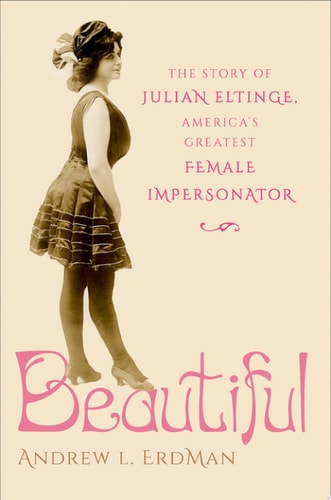
Beautiful: The Story of Julian Eltinge, America's Greatest Female Impersonator
0
0
As an Amazon Associate and affiliate partner, Menrva Books earns from qualifying purchases. Learn more
Author Description
From the late 19th to the early 21st centuries, female impersonation was a hugely popular performance genre. Long before today's popular television shows, men in colleges, business, and even the military formed drag clubs and put on musicals and variety shows of all kinds with little fear of negative judgment. But no female impersonator was as famous, successful, or highly-regarded as Julian Eltinge (1881-1941). Eltinge, born William Dalton just outside Boston, started playing female characters and imitating women with his mother's encouragement as a child while his father shuttled his family around the Americas in search of a mining fortune that never materialized. The future drag star returned to Boston in his late teens where he quickly rose through the ranks of semi-amateur all-male musicals, then transitioned to vaudeville, and eventually starred in hugely successful musical comedies such as The Fascinating Widow (1910).For decades, the Julian Eltinge Theatre on West 42nd Street bore testament to his stature. But Eltinge longed to play serious roles which did not require him to impersonate women; it was a lifelong struggle. He constructed a hypermasculine offstage persona-- a cigar-loving former Harvard athlete who beat up anyone who questioned his manliness--most of which wasn't true. But Eltinge's efforts were essential in a culture increasingly focused on separating “real men” from “inverts” and “perverts,” demanding men define themselves in new ways during a time of economic and cultural upheaval. During his heyday, Eltinge published a beauty and advice magazine for women, launched lifestyle-brand makeup and skincare products, and became a paid spokesperson for corsets and women's shoes, all without a hint of irony. Julian Eltinge's success with mainstream audiences, ever avoiding suspicions and scandal, says much about the emergent middle-class white heteronormativity of the era and what we have come to think of as the social construction of gender.
Menrva's Summary
THE THESIS
This biography investigates how Julian Eltinge, the most prominent female impersonator of the early 20th century, navigated the rigid gender norms of his era while achieving unprecedented mainstream success. Andrew L. Erdman, a scholar of theater history, utilizes archival research and primary source materials to reconstruct Eltinge's life from his childhood in Boston to his peak as a vaudeville star. The book argues that Eltinge's carefully curated hypermasculine public persona was a strategic response to the cultural anxieties surrounding gender identity and sexuality during a period of significant social transition.
THE SCOPE MAP
What You Will Find
- A detailed examination of the vaudeville circuit and early 20th-century musical comedy.
- Analysis of the social construction of gender and heteronormativity in the United States.
- Historical context regarding the evolution of drag performance and its transition from mainstream entertainment to a marginalized practice.
- Insights into Eltinge's commercial ventures, including his beauty magazine and lifestyle branding.
THE AUTHORITY PERSPECTIVE
Critics and historians recognize this work as a significant contribution to the study of American performance history and gender performance. Readers frequently note the meticulous research and the author's ability to contextualize Eltinge's career within the broader cultural shifts of the early 20th century.
Page Count:
368
Publication Date:
2024-01-01
Publisher:
Oxford University Press
ISBN-10:
0197696333
ISBN-13:
9780197696330
History
Biography
Gender Studies
Vaudeville
Theater
Community Tags
Other Editions(2)
Similar Books



Reader Comments
Share Your Thoughts
No comments yet. Be the first to share your thoughts!