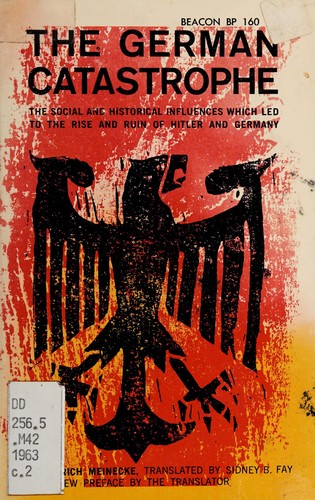
The German Catastrophe
0
0
As an Amazon Associate and affiliate partner, Menrva Books earns from qualifying purchases. Learn more
Author Description
Volume 5. Wilhelmine Germany and the First World War (1890-1918) Friedrich Meinecke, The German Catastrophe: Reflections and Recollections (1946) Here, the historian Friedrich Meinecke (1862-1964) reflects on the “Spirit of 1914,” a transient sense of unity felt by Germans during the initial stages of the First World War. Free from romantic notions of national solidarity, Meinecke also addresses the fissures in German society that reasserted themselves several months after the war began. III. THE GERMAN PEOPLE DURING THE FIRST WORLD WAR When the First World War broke out, it seemed once more that a good angel might lead the German people back to the right path. The exaltation of spirit experienced during the August days of 1914, in spite of its ephemeral character, is one of the more precious, unforgettable memories of the highest sort. All the rifts which had hitherto existed in the German people, both within the bourgeoisie and between the bourgeoisie and the working classes, were suddenly closed in the face of the common danger which snatched us out of the security of the material prosperity that we had been enjoying. And more than that, one perceived in all camps that it was not a matter merely of the unity of a gain-seeking partnership, but that an inner renovation of our whole state and culture was needed. We generally believed indeed that this had already commenced and that it would progress further in the common experiences of the war, which was looked upon as a war of defense and self-protection. We underwent a rare disappointment in our hopes. Within a year the unity was shattered and the German people were again separated upon various paths. Was the uplift of August 1914 after all merely the last flickering of older evolutionary forces which were now coming to an end? A good observer, Max Hildebert Böhm, suspected as much in 1917. He wrote in the Preussische Jahrbücher (volume 167): “In many respects August 1914 will perhaps at a later time look much le
Menrva's Summary
THE THESIS
Friedrich Meinecke grapples with the profound national disillusionment following Germany's defeat in World War I. Meinecke, a prominent historian, reflects on the initial surge of national unity in August 1914, a sentiment he terms the "Spirit of 1914." He critically examines how this ephemeral unity dissolved within a year, exposing deep societal fissures that reasserted themselves, leading to a catastrophic outcome for Germany.
THE SCOPE MAP
- Analysis of the "Spirit of 1914" and its transient nature.
- Examination of the societal rifts within the German bourgeoisie and between classes.
- Reflection on the perceived "war of defense and self-protection."
- Discussion of the disappointment when initial hopes for unity were not sustained.
- Consideration of Max Hildebert Böhm's observation on August 1914 as a potential end of older evolutionary forces.
- Exploration of the inner renovation needed for German state and culture.
THE AUTHORITY PERSPECTIVE
Friedrich Meinecke's "The German Catastrophe" offers a poignant retrospective on Germany's experience during World War I. The work is noted for its introspective analysis of national unity and its subsequent fragmentation. Meinecke's reflections provide a critical look at the societal dynamics that shaped Germany's wartime trajectory and its post-war consequences. The book serves as a significant historical document for understanding the intellectual climate of post-war Germany.
Page Count:
121
Publication Date:
1963-01-01
ISBN-10:
0807056677
ISBN-13:
9780807056677
History
Non-Fiction
Sociology
German history
Community Tags
Similar Books