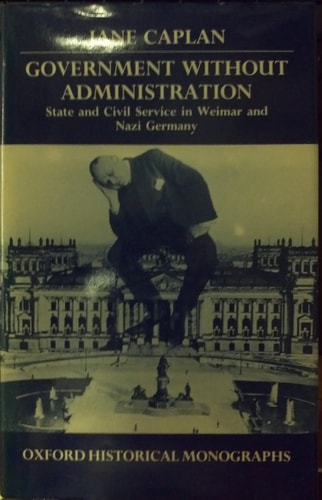
Government Without Administration: State and Civil Service in Weimar and Nazi Germany
0
0
As an Amazon Associate and affiliate partner, Menrva Books earns from qualifying purchases. Learn more
Author Description
This study analyzes administrative policymaking and the organization of the civil service in Germany between 1918 and 1945. Although focusing particularly on the period of National Socialist rule, Caplan argues that the politicization of the administration between 1933 and 1945 cannot be understood without understanding both the longer-term history of German bureaucracy and the specific problems of policy in the Weimar Republic. She further contends that the status of the civil service as an apolitical and supra-social institution was under extreme strain by the 1920s, and that the National Socialist regime was only one episode in the ruptured process of state formation in modern Germany, and presents an illuminating series of case studies of the role of the Reich interior ministry.
Menrva's Summary
THE THESIS
This book investigates the structural evolution and politicization of the German civil service during the transition from the Weimar Republic to the National Socialist regime. Jane Caplan, a scholar of modern German history, utilizes archival research and administrative records to challenge the notion that Nazi bureaucracy was a monolithic entity. She argues that the collapse of the civil service's traditional status as an apolitical institution began well before 1933, rooted in the systemic crises and policy failures of the Weimar era.
THE SCOPE MAP
What You Will Find
- Analysis of administrative policymaking in Germany from 1918 to 1945.
- Examination of the Reich interior ministry as a primary case study.
- Historical evaluation of the civil service as a supra-social institution under political strain.
- Assessment of the continuity and rupture in state formation processes across two distinct regimes.
THE AUTHORITY PERSPECTIVE
Historians and political scientists frequently cite this work as a foundational text for understanding the internal mechanics of the German state during the early twentieth century. Readers often note the academic density of the prose, which provides a rigorous examination of bureaucratic development rather than a general narrative history.
Page Count:
382
Publication Date:
1989-02-16
Publisher:
Oxford University Press
ISBN-10:
0198229933
ISBN-13:
9780198229933
History
Public Administration
European History
Government
German history
Community Tags
Similar Books