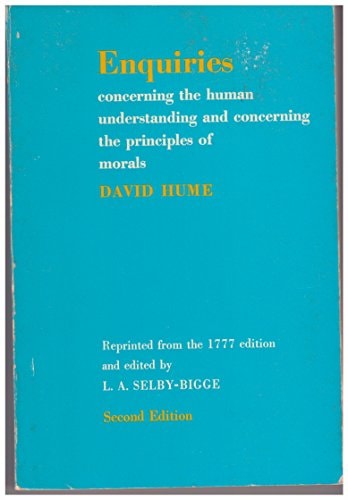
Enquiries Concerning the Human Understanding and Concerning the Principles of Morals
0
0
As an Amazon Associate and affiliate partner, Menrva Books earns from qualifying purchases. Learn more
Author Description
Hume's excellent account of human nature and mental functioning is published here complete and inclusive of original notes.Often referred to as simply 'The Enquiry', this work is notable for setting forth a number of the concepts which would come to define David Hume's contribution to empirical philosophy. Although selling poorly at the time of first publication in 1748, this book found recognition following Hume's death as his ideas became increasingly appreciated in academic circles.An Enquiry Concerning Human Understanding has an intuitive layout - commencing with an introduction to the philosophic matters at hand, Hume delves incrementally into his beliefs on the nature of the human being. The means by which people mentally formulate ideas occupies a large tract of the work, while the process of learning, assimilating and memorising information is also discussed.Later chapters focus on abstract topics, including the relation of probability to human activity, the inter-relatedness of individual ideas, and the merits of societal liberty in allowing man to exert his free will. Comparisons of human perception and behaviour with members of the animal kingdom, together with an examination of human testimony in the context of miraculous events, are also present.Today, this work by Hume is considered a classic of Enlightenment era philosophy, and remains a required text in many university courses.
Menrva's Summary
THE THESIS
This work investigates the foundational mechanisms of human cognition and the moral principles that govern human conduct through the lens of empirical observation. David Hume, a central figure of the Scottish Enlightenment, utilizes a systematic approach to dismantle metaphysical speculation in favor of experience-based reasoning. He argues that human understanding is rooted in sensory perception and the association of ideas, while moral judgments are derived from sentiment rather than pure abstract logic. By applying this framework, Hume seeks to clarify the limits of human knowledge and the nature of moral obligation.
THE SCOPE MAP
What You Will Find
- An analysis of the origin of ideas and the process of mental association.
- A critique of causality and the role of probability in human belief systems.
- An examination of human testimony regarding miracles and supernatural events.
- A discussion on the foundations of morality, focusing on utility and social sentiment.
- Comparative observations between human cognitive processes and animal behavior.
THE AUTHORITY PERSPECTIVE
Experts recognize this text as a foundational pillar of modern empiricism and a critical document for understanding 18th-century philosophical discourse. Readers frequently note the academic density of the prose, which requires careful attention to follow Hume's logical progression through complex epistemological arguments.
Page Count:
390
Publication Date:
1966-01-01
Publisher:
Open Court
ISBN-10:
0198243073
ISBN-13:
9780198243076
Philosophy
Politics
Epistemology
Empiricism
Ethics
Ethics & Morality
Enlightenment
Community Tags
Similar Books