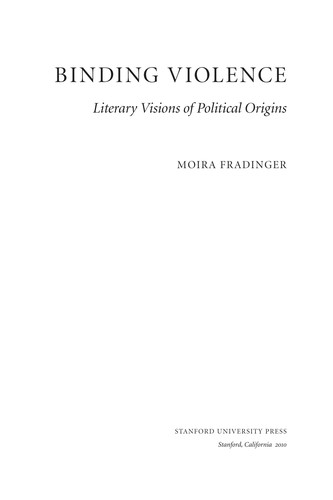
Binding Violence
0
0
As an Amazon Associate and affiliate partner, Menrva Books earns from qualifying purchases. Learn more
Author Description
From the publisher. Binding Violence exposes the relation between literary imagination, autonomous politics, and violence through the close analysis of literary texts{u2014}in particular Sophocles' Antigone, D.A.F. de Sade's 120 Days of Sodom, and Vargas Llosa's The Feast of the Goat{u2014}that speak to a blind spot in democratic theory, namely, how we decide democratically on the borders of our political communities. These works bear the imprint of the anxieties of democracy concerning its other{u2014}violence{u2014}especially when the question of a redefinition of membership is at stake. The book shares the philosophical interest in rethinking politics that has recently surfaced at the crossroads of literary criticism, philosophy, critical theory, and psychoanalysis. Fradinger takes seriously the responsibility to think through and give names to the political uses of violence and to provoke useful reflection on the problem of violence as it relates to politics and on literature as it relates to its times.
Menrva's Summary
THE THESIS
THE THESIS
Binding Violence investigates the complex relationship between literary imagination, autonomous politics, and violence, focusing on how democratic societies grapple with defining the boundaries of their political communities. Through close analysis of literary works such as Sophocles' Antigone, D.A.F. de Sade's 120 Days of Sodom, and Vargas Llosa's The Feast of the Goat, Fradinger examines how these texts expose a critical blind spot in democratic theory concerning the role of violence. The book argues that these literary works reflect democratic anxieties about their 'other'—violence—particularly when the redefinition of membership is at stake.
THE SCOPE MAP
- What You Will Find:
- Analysis of literary texts including Sophocles' Antigone, D.A.F. de Sade's 120 Days of Sodom, and Vargas Llosa's The Feast of the Goat.
- Exploration of the intersection between literary imagination, autonomous politics, and violence.
- Examination of how literature addresses democratic theory's blind spot regarding the borders of political communities.
- Discussion of democratic anxieties concerning violence and the redefinition of membership.
- Engagement with philosophical and critical theory perspectives on politics and violence.
THE AUTHORITY PERSPECTIVE
THE AUTHORITY PERSPECTIVE
This book is recognized for its rigorous engagement with political theory and literary criticism, offering a unique perspective on the concept of violence within democratic frameworks. Fradinger's analysis of key literary works provides a critical lens through which to understand the inherent tensions in defining political communities. The work is noted for its contribution to interdisciplinary scholarship, bridging literary studies with philosophy and political thought.
Page Count:
0
Publication Date:
2010-01-01
ISBN-10:
0804763305
ISBN-13:
9780804763301
Politics
Philosophy
Non-Fiction
Political Theory
Literary Criticism
Community Tags
Similar Books