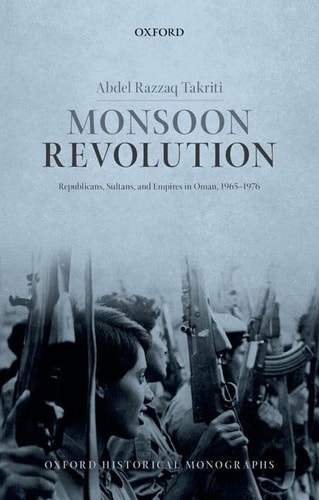
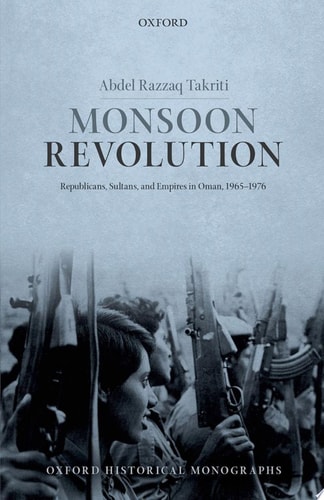
Monsoon Revolution: Republicans, Sultans, and Empires in Oman, 1965-1976
0
0
As an Amazon Associate and affiliate partner, Menrva Books earns from qualifying purchases. Learn more
Author Description
At a time when Arab revolutionary movements are once again dominating the headlines, Monsoon Revolution offers a fresh reading of the Arab revolutionary tradition, examining one of its foremost illustrations.The Dhufar revolution in Oman (1965-1976) was the longest running major armed struggle in the history of the Arabian Peninsula - Britain's last classic colonial war in the region - and one of the highlights of the Cold War in the Middle East. Monsoon Revolution retrieves the political, social, and cultural history of that remarkable process. It analyses its causes, course, and outcomes, while uncovering the networks, ideologies, personalities, as well as the regional and global actors that sustained it. Relying upon a wide range of untapped Arab and British archival and oral sources, it revises the modern political history of Oman by revealing the centrality of popular movements in shaping events and outcomes. Monsoon Revolution further examines colonial dynamics, narrating the ways through which Sultanic absolutism was constructed by Britain in order to suppress the persistent local revolutionary challenge. A series of landmark mysteries are also solved, including the details of the 1970 coup bringing the current ruler onto the throne.Contextualising Omani revolution and absolutism, Abdel Razzaq Takriti illustrates how the events that unfolded in Oman during the years 1965-1976 were embedded in broader Arab and international currents. The Sultanate's dependence on global networks of imperial and monarchical solidarity is examined and the fundamental importance of these networks for its own survival is highlighted. On the other side, the ties that bound transnational anti-colonial movements and revolutionary networks are explored, and Dhufar is revealed to be an ideal vantage point from which to demonstrate the centrality of South-South connections in modern Arab history.
Menrva's Summary
THE THESIS
This work investigates the origins, trajectory, and geopolitical significance of the Dhufar revolution in Oman, questioning how a localized armed struggle became a focal point for Cold War dynamics and anti-colonial resistance. Abdel Razzaq Takriti, a scholar of modern Arab history, utilizes a robust framework of previously untapped British and Arab archival materials alongside oral histories. He argues that the conflict was not merely a regional skirmish but a central event in the history of the Arabian Peninsula, shaped by the interplay between popular revolutionary movements and the British-backed construction of Sultanic absolutism.
THE SCOPE MAP
What You Will Find
- A detailed historical analysis of the Dhufar revolution spanning the years 1965 to 1976.
- Examination of the 1970 Omani coup and the subsequent consolidation of Sultanic power.
- Analysis of transnational revolutionary networks and South-South political connections.
- Investigation into the role of British imperial policy and global monarchical solidarity in suppressing local uprisings.
THE AUTHORITY PERSPECTIVE
Experts identify this monograph as a rigorous re-evaluation of Omani political history that successfully challenges traditional colonial narratives. Readers frequently note the high level of archival detail and the scholarly density of the prose, making it a foundational text for those studying Middle Eastern revolutionary movements.
Page Count:
352
Publication Date:
2016-11-01
Publisher:
Oxford University Press
ISBN-10:
0198783175
ISBN-13:
9780198783176
History
Military History
Middle Eastern
Colonialism
Middle East
Oman
Community Tags
Other Editions(2)
Similar Books









Reader Comments
Share Your Thoughts
No comments yet. Be the first to share your thoughts!