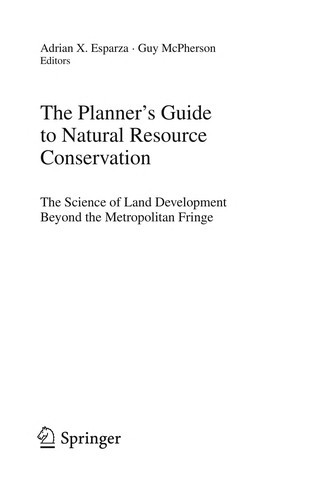
The Planner's Guide to Natural Resource Conservation
0
0
As an Amazon Associate and affiliate partner, Menrva Books earns from qualifying purchases. Learn more
Author Description
Much of the country’s recent population growth is situated beyond the metropolitan fringe, where development consumes millions of acres of privately owned land. Exurbanization has become the dominant pattern of land development in America and there is no indication it will slow in the future. This development depletes agricultural and wildlands, and causes numerous environmental impacts ranging from the loss of biodiversity and wildland habitats to soil erosion, an increase in nonnative species, and the heightened threat to endangered species. Written for regional planners, planning commissions, local elected officials, environmental groups, and the public-at-large, The Planner’s Guide to Natural Resource Conservation provides readers from diverse, nonscientific backgrounds with a working knowledge of how and why exurbanization impacts environmental systems.^ Contributors include experts in rangeland ecology, restoration ecology, zoology, urban and regional planning, and conservation biology, who highlight the best practices to mitigate environmental problems or to avoid them altogether. Each chapter will leave readers with a firm grasp of relevant concepts and processes, an understanding of current research, and the know-how to apply science to land-use decisions. Adrian X. Esparza is Associate Professor in the School of Natural Resources at the University of Arizona (Ph.D. 1987, University of Illinois-Urbana). He taught previously in the School of Planning, College of Architecture at the University of Arizona. His research focuses on exurban land development in the southwest United States and urbanization in the United States-Mexico border region. He has published dozens of articles in the fields of urban and regional planning and regional science.^ Guy McPherson is a Professor in the School of Natural Resources at the University of Arizona (Ph.D. 1987, Texas Tech University). He also worked for the University of Georgia, Texas A & M University, University of Cali
Menrva's Summary
THE THESIS
Exurbanization's relentless expansion poses a significant threat to natural resources, demanding informed planning strategies to mitigate its environmental consequences. This book addresses the dominant pattern of land development in America, where growth beyond metropolitan fringes consumes millions of acres of privately owned land, leading to the depletion of agricultural and wildlands. It details environmental impacts such as biodiversity loss, habitat destruction, soil erosion, and increased threats to endangered species. Written for a diverse audience including planners, officials, environmental groups, and the public, it aims to provide a working knowledge of how exurbanization affects environmental systems.
THE SCOPE MAP
- Expert insights into the ecological impacts of exurban land development.
- Best practices for mitigating or avoiding environmental problems caused by development.
- An overview of relevant concepts and processes in natural resource conservation.
- Summaries of current research in urban and regional planning and conservation biology.
- Guidance on applying scientific knowledge to land-use decisions.
THE AUTHORITY PERSPECTIVE
The book is presented as a practical guide for professionals and the public concerned with the environmental impacts of exurban development. Contributors are noted experts in various ecological and planning fields, suggesting a comprehensive and authoritative approach. The content is designed to equip readers with applicable knowledge for making informed land-use decisions, indicating a focus on actionable strategies and scientific understanding. The framing suggests it serves as a valuable resource for those seeking to balance development with conservation efforts.
Page Count:
258
Publication Date:
2009-01-01
ISBN-10:
0387981667
ISBN-13:
9780387981666
Non-Fiction
Science
Nature
urban planning
Ecology
Land Use
Conservation
Community Tags
Similar Books