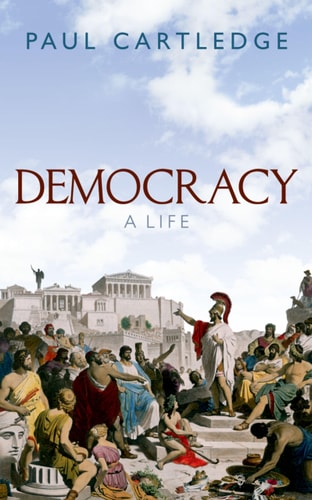
Democracy: A Life
0
0
As an Amazon Associate and affiliate partner, Menrva Books earns from qualifying purchases. Learn more
Author Description
Democracy is either aspired to as a goal or cherished as a birthright by billions of people throughout the world today ― and has been been for over a century. But what does it mean? And how has its meaning changed since it was first coined in ancient Greece?Democracy: A Life is a biography of the concept, looking at its many different manifestations and showing how it has changed over its long life, from ancient times right through to the present. For instance, how did the 'people power' of the Athenians emerge in the first place? Once it had emerged, what enabled it to survive? And how did the Athenian version of democracy differ from the many other forms that developed among the myriad cities of the Greek world?Paul Cartledge answers all these questions and more, following the development of ancient political thinking about democracy from the sixth century BC onwards, not least the many arguments that were advanced against it over the centuries. As Cartledge shows, after a golden age in the fourth century BC, there was a long, slow degradation of the original Greek conception and practice of democracy, from the Hellenistic era, through late Republican and early Imperial Rome, down to early Byzantium in the sixth century CE.For many centuries after that, from late Antiquity, through the Middle Ages, to the Renaissance, democracy was effectively eclipsed by other forms of government, in both theory and practice. But as we know, this was by no means the end of the story. For democracy was eventually to enjoy a re-florescence, over two thousand years after its first flowering in the ancient world: initially revived in seventeenth-century England, it was to undergo a further renaissance in the revolutionary climate of late-eighteenth-century North America and France ― and has been constantly reconstituted and reinvented ever since.
Menrva's Summary
THE THESIS
How has the concept of democracy evolved from its inception in ancient Greece to its contemporary global status as a widely sought political ideal? Paul Cartledge, a renowned scholar of ancient Greek history, provides a comprehensive biography of democracy as an idea and a practice. He examines the historical trajectory of the term, tracing its origins in Athenian 'people power,' its subsequent decline through the Roman and Byzantine eras, and its eventual modern resurgence in the West. By analyzing political theory and historical shifts, Cartledge demonstrates that democracy is a fluid, constantly reinvented construct rather than a static political system.
THE SCOPE MAP
What You Will Find
- A detailed historical analysis of Athenian democracy from the sixth century BC through the Hellenistic period.
- An examination of the long eclipse of democratic theory during the Middle Ages and the Renaissance.
- A study of the revival of democratic ideals in seventeenth-century England and the revolutionary eras of North America and France.
- A critical evaluation of the arguments historically advanced against democratic governance.
THE AUTHORITY PERSPECTIVE
Scholars and readers frequently note the academic rigor and historical depth Cartledge brings to this expansive survey. Experts highlight this work as a foundational text for understanding the long-term evolution of political thought and the historical context of modern democratic institutions.
Page Count:
416
Publication Date:
2018-04-12
Publisher:
OUP Oxford
ISBN-10:
0198815131
ISBN-13:
9780198815136
Politics
Philosophy
History
Democracy history
Cultural Anthropology
Politics & Government
Educational Resources
Ancient History
Special Topics
Government
Community Tags
Other Editions(3)

Similar Books


Reader Comments
Share Your Thoughts
No comments yet. Be the first to share your thoughts!