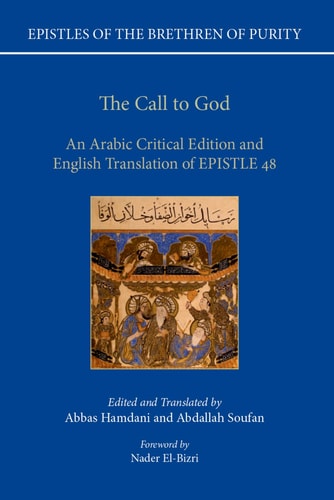
The Call to God: An Arabic Critical Edition and English Translation of Epistle 48 (Epistles of the Brethren of Purity)
0
0
As an Amazon Associate and affiliate partner, Menrva Books earns from qualifying purchases. Learn more
Author Description
The Brethren of Purity, the anonymous adepts of a tenth-century esoteric fraternity based in Basra and Baghdad, hold an eminent position in the history of science and philosophy in Islam due to the wide reception and assimilation of their monumental encyclopaedia, the Epistles of the Brethren of Purity. This compendium contains fifty-two epistles offering synoptic accounts of the classical sciences and philosophies of the age; divided into four classificatory parts, it treats themes in mathematics, logic, natural philosophy, psychology, metaphysics, and theology, in addition to didactic fables.Epistle 48 belongs to the fourth part dealing with Divine-Legal matters. It deals specifically with methods that should be employed in advocating for the cause of the fraternity, and in calling different segments of society to join its ranks. The targeted segments include philosophers, kings, Shi'is, and administrators. Special templates for preachers engaging with these particular categories are provided throughout. It also addresses issues of governance and the ideal city, while emphasizing again the primacy of the soul over the body, and the need for followers to know themselves. The Epistle ends with a story based on the famous Bilawhar wa-Budhasaf, given as an illustration of a successful mission. Epistle 48 reveals, more than any other epistle, the political nature of the fraternity and its mission, being, as the editors argue, part of the Fatimid missionary efforts in the period preceding the establishment of the Fatimid Dynasty.
Menrva's Summary
THE THESIS
This volume investigates the political and proselytizing strategies of the tenth-century esoteric fraternity known as the Brethren of Purity through a critical analysis of their forty-eighth epistle. Abbas Hamdani and Abdallah Soufan provide a scholarly framework that situates this text within the broader context of Fatimid missionary efforts. By examining the specific methodologies for recruitment and governance outlined in the epistle, the authors argue that the fraternity functioned as a sophisticated political entity rather than a purely philosophical society.
THE SCOPE MAP
What You Will Find
- A bilingual critical edition featuring the original Arabic text alongside an English translation.
- Detailed analysis of recruitment templates tailored for diverse societal segments including philosophers, kings, and administrators.
- Exploration of the intersection between Neoplatonic metaphysics and the practical requirements of governance in the ideal city.
- Historical evidence linking the fraternity's mission to the political climate preceding the establishment of the Fatimid Dynasty.
THE AUTHORITY PERSPECTIVE
Scholars recognize this edition as a vital resource for understanding the political dimensions of the Epistles of the Brethren of Purity. The text is noted for its academic rigor and its contribution to the study of medieval Islamic intellectual history.
Page Count:
480
Publication Date:
2019-10-01
Publisher:
Oxford University Press
ISBN-10:
0198838980
ISBN-13:
9780198838982
Religion
Philosophy
History
Islam
God Islam
Ikhwan Al-safa
Community Tags
Similar Books