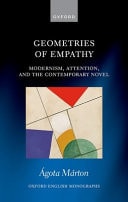
Geometries of Empathy
0
0
As an Amazon Associate and affiliate partner, Menrva Books earns from qualifying purchases. Learn more
Author Description
What Does It Mean To Empathise Today? Virginia Woolf Was Convinced That The Form Of The Novel, So Clumsy, Verbose, And Undramatic, So Rich, Elastic, And Alive, Has Been Evolved First And Foremost To Express Character. But To What Extent Can The Novel Capture The Unlimited Capacity And Infinite Variety Of Other Minds And Lives? This Question Resonates With Many Twenty-first-century Anglophone Novelists Who Reimagine The Possibility Of Empathic Exchange. By Revealing The Origins Of The Term Empathy In Modernist Aesthetics, Ágota Márton Offers A Radical New Perspective On The Contemporary Novel. Translated Into English In 1908 From The German Einfühlung, Empathy Did Not Initially Mean Sharing Or Understanding The Feelings Of Another Human. It Described Imaginative Projection Into A Work Of Art Or An Object. Empathy Implied Unknowability, Un-ownability. Hesitancy And Withholding, Even Self-erasure, Become Intrinsic To Understanding The Outer World. This Aesthetic Phenomenology Profoundly Informed Modernist Experiments In The Novel. But It's Also Deeply Relevant To Post-millennial Fiction. Through Explicit Dialogue With Their Modernist Predecessors, Novelists Such As Ian Mcewan, Zadie Smith, Rachel Cusk, Amit Chaudhuri, And Ciaran Carson Experiment With Attentional Modes That Test The Scale And Sources, The Very Possibility, Of Empathic Exchange. In Their Work There Are No Fixed Subject Positions; Transparent Access To Others Is Impossible. Márton Shows How Empathy With Others Must Instead Be Mediated Through Geometrical Shapes And Forms: Circles, Lines, Rectangles, Surfaces, Symmetries, Prisms Of Attention. Sculpting New Modes Of Detached Immersion, These Novelists Are Rethinking What It Means To 'make Space' For The Other-- Provided By Publisher.
Menrva's Summary
THE THESIS
This book investigates the evolving definition of empathy within the novel, questioning whether the form can truly capture the infinite variety of other minds. Ágota Márton, a scholar of modernist aesthetics, traces the etymological and philosophical origins of the term 'empathy' from its German roots in Einfühlung to its current usage in contemporary literature. She argues that modernists originally viewed empathy as an imaginative projection into art rather than a simple sharing of human feelings, a concept that continues to shape how post-millennial novelists approach the representation of otherness.
THE SCOPE MAP
What You Will Find
- An etymological history of the term empathy, tracing its translation from the German Einfühlung in 1908.
- An analysis of modernist aesthetic phenomenology and its influence on contemporary narrative techniques.
- Case studies of novelists including Ian McEwan, Zadie Smith, Rachel Cusk, Amit Chaudhuri, and Ciaran Carson.
- A theoretical framework examining how geometrical metaphors like lines, surfaces, and prisms mediate the act of understanding others.
THE AUTHORITY PERSPECTIVE
Scholars and critics recognize this work as a rigorous intervention in the study of modernist aesthetics and contemporary narrative theory. Readers frequently note the academic density of the prose, which provides a sophisticated lens for understanding how modern fiction navigates the limits of human connection.
Page Count:
0
Publication Date:
2025-01-01
Publisher:
New York : Oxford University Press,
ISBN-10:
019898331X
ISBN-13:
9780198983316
Contemporary
Philosophy
Literary Criticism
Literary theory
Modernism
Community Tags
Similar Books