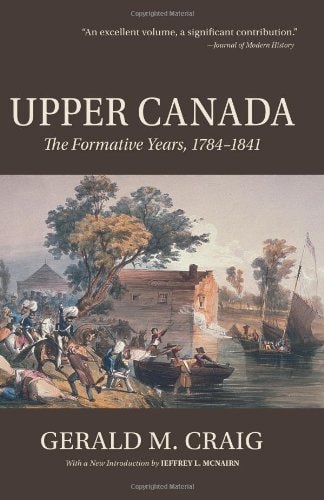
Upper Canada: The Formative Years, 1784-1841
0
0
As an Amazon Associate and affiliate partner, Menrva Books earns from qualifying purchases. Learn more
Author Description
Gerald M. Craig's history, first published fifty years ago, is still considered one of the best depictions of Upper Canada ever written. Beginning in the early 1770s, Craig evocatively recounts the region's development from a "few scattered pioneer settlements" to an advanced society in the early 1840s. In these years, Ontario as we know it was forged, from education, transportation, and government to relations with the newly independent United States of America.Ontario's formative years were marked by growth and change, as well as political upheaval. In the late 1770s, the fertile land of what would become Upper Canada was sparsely settled. As some forty thousand British Loyalists left revolutionary America and moved north and west, many came to this region, bringing with them a wide range of expectations, knowledge, and skills-not to mention a new range of problems. Land was purchased from the Mississaugas and other First Nations groups and allocated to the Loyalists to build homes and farms, paving the way for future land conflict.As Craig recounts, British officials began to organize a government that could accommodate the newcomers, as well as French- and English-speakers. This entailed, among other things, addressing the overall constitutional issue of Canada. A legislative council, legislative assembly, and governor were installed, modelled on the British parliamentary system-a structure that would undergo significant change over the next sixty years. In vivid detail Craig retells the landmark events of the time, including the abolishment of slavery, establishment of a bilingual nation, the Family Compact, the War of 1812, and the Rebellions of 1837. At the end of his history is the formation of the Province of Canada in 1841-the country's final incarnation before Confederation.This wide-ranging account addresses the growth and conflict, both internal and external, seen in the sixty years following the influx of the Loyalists and explores the politics and soc
Menrva's Summary
THE THESIS
How did the influx of British Loyalists and the subsequent political and social pressures transform a sparsely settled frontier into the organized Province of Canada by 1841? Gerald M. Craig, a respected historian of the Canadian experience, utilizes extensive archival research and primary source documentation to trace the evolution of Upper Canada. The work argues that the region's development was defined by a constant tension between colonial administration, the integration of diverse populations, and the struggle for representative government. By examining the period from 1784 to 1841, the author provides a comprehensive framework for understanding the foundational structures of modern Ontario.
THE SCOPE MAP
What You Will Find
- Detailed analysis of the socio-political impact of the British Loyalist migration following the American Revolution.
- Examination of the establishment and evolution of the legislative council, assembly, and the British parliamentary model.
- Historical accounts of pivotal events including the War of 1812, the abolition of slavery, and the Rebellions of 1837.
- Exploration of land distribution policies and the complex interactions with First Nations groups such as the Mississaugas.
THE AUTHORITY PERSPECTIVE
Experts and historians consistently cite this work as a foundational text for understanding the early development of Upper Canada. Readers frequently note the academic density of the prose, which provides a rigorous and thorough examination of the period's political and social complexities.
Page Count:
317
Publication Date:
2014-01-01
Publisher:
Oxford University Press
ISBN-10:
019900904X
ISBN-13:
9780199009046
History
Canadian History
Politics & Government
Political History
Social History
Colonial History
Community Tags
Similar Books