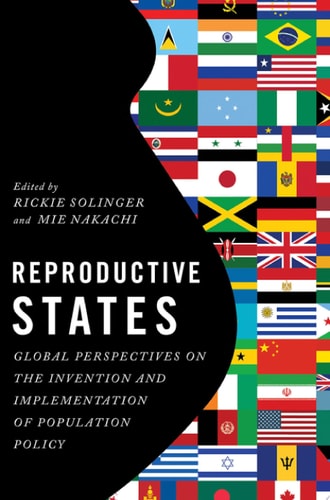
Reproductive States: Global Perspectives on the Invention and Implementation of Population Policy
0
0
As an Amazon Associate and affiliate partner, Menrva Books earns from qualifying purchases. Learn more
Author Description
When it comes to government's role in personal matters such as family planning, most bristle at any interference from the State on how to exercise their reproductive rights. China's infamous "one child" policy is a well-known example of reproductive politics, but history is filled with other examples of governmental population control to advance its interests. Reproductive States is the first volume of a collection of case studies that explores when and how some of the most populous countries in the world invented and implemented state population policies in the 20th century.The authors, scholars specializing in reproductive politics, survey population policies from key countries on five continents to provide a global perspective. Regardless of the type of government or its cultural history, many of these countries have developed similar policies to control their populations and attempt to combat social problems such as poverty and hunger. However, the common denominator is that states have used women's bodies as a political resource.Far from being just an overseas problem, this volume illustrates how other countries have developed their strategies in response to goals and tactics driven by the United Nations and the United States. Due to fears of a post-World War II "population bomb" and uncertainty of how to deal with the world's poor after the Cold War, the U.S. and the Soviet Union led the charge among nations to devise strategies to control their populations, but in different ways. The U.S. and some European countries pressed the poor and ethnic minorities to limit reproduction. China's "one child" policy targeted all ranks of society, while Soviet women (who already had few rights) were under surveillance through state-planned services such as medical care and commodity distribution to detect pregnancy.Interweaving biopolitics, gender studies, statecraft, and world systems, Reproductive States offer reflections on the outcome of such policies and their legacies.
Menrva's Summary
THE THESIS
This volume investigates how diverse global governments have historically utilized reproductive policies as instruments of statecraft to manage population growth and address socioeconomic challenges. The authors, Mie Nakachi and Rickie Solinger, leverage their expertise in reproductive politics to analyze how states across five continents have treated women's bodies as political resources throughout the 20th century. By examining the influence of international actors like the United Nations and the United States, the text argues that population control strategies are rarely isolated domestic decisions but are instead deeply embedded in global power dynamics and Cold War-era anxieties.
THE SCOPE MAP
What You Will Find
- Comparative case studies of population policies from nations across five continents.
- An analysis of the intersection between biopolitics, gender studies, and state-planned services.
- Examination of the influence of the United States and the Soviet Union on global reproductive strategies.
- Historical assessment of how poverty, hunger, and ethnic demographics have been used to justify state intervention.
THE AUTHORITY PERSPECTIVE
Experts recognize this work as a significant contribution to the study of global biopolitics and state-led reproductive control. Readers frequently note the academic rigor of the comparative analysis, which provides a necessary framework for understanding the historical legacies of population management.
Page Count:
400
Publication Date:
2016-01-04
Publisher:
Oxford University Press
ISBN-10:
0199311080
ISBN-13:
9780199311088
History
Sociology
Reproductive Technology
Public Policy
Gender Studies
Community Tags
Other Editions(2)
Similar Books








Reader Comments
Share Your Thoughts
No comments yet. Be the first to share your thoughts!