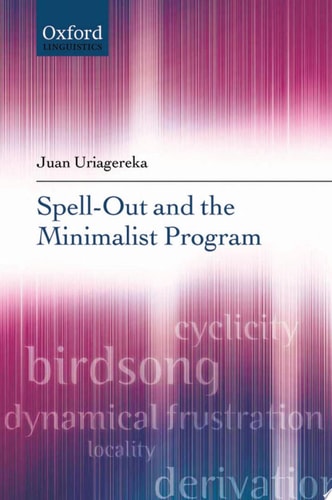
Spell-Out and the Minimalist Program
0
0
As an Amazon Associate and affiliate partner, Menrva Books earns from qualifying purchases. Learn more
Author Description
Since Juan Uriagereka originated the multiple spell-out model in 1999 it has been one of the most influential lines of research in syntactic theorizing. The model simplified a crucial element of the minimalist account of language making it a more accurate reflection of syntax and its acquisition. In this book he explores important consequences of the multiple spell-out hypothesis and of the linked notion of cyclicity. He combines the latest thinking in linguistics with perspectives drawn from physics, biology, and animal behavior, aiming thereby to advance the field first described by Noam Chomsky as biolinguistics.Without simplifying them Professor Uriagereka seeks to present the issues and their broader biological significance clearly and succinctly in ways that are accessible to scholars from adjacent fields with a limited background in linguistics. His analogies and comparisons between linguistic and non-linguistic phenomena (such as the syntax of birdsong) will be of value to both non-linguists and linguists, whose overriding concerns with narrow linguistic questions may sometimes obscure their broader biological significance.The subjects discussed in the book include the linearization of structure, the punctuated nature of a derivation (the multiple spell-out model), cyclicity and its consequences for locality, and the definition of c-command and its relevance to various types of grammatical dependency. The author discusses the evolutionary implications of his work, considering, for example, whether the punctuated nature of the derivation is a resolution of conflicting demands that yield an equilibrium found in nature more generally. This groundbreaking book will appeal to a wide range of readers in linguistics and cognitive science.
Menrva's Summary
THE THESIS
This book investigates the theoretical implications and biological significance of the multiple spell-out model within the framework of the Minimalist Program. Juan Uriagereka, a prominent figure in syntactic research, draws upon his original 1999 model to examine how the punctuated nature of linguistic derivation reflects broader principles found in physics and biology. By bridging the gap between narrow syntactic questions and evolutionary theory, the author argues that the mechanisms of language acquisition and structure may be understood as resolutions to conflicting natural demands.
THE SCOPE MAP
What You Will Find
- Analysis of the multiple spell-out model and its role in syntactic derivation.
- Examination of cyclicity, locality, and the definition of c-command in grammatical dependency.
- Comparative studies between human language syntax and non-linguistic phenomena such as birdsong.
- Discussion on the evolutionary implications of punctuated derivations and their relation to natural equilibrium.
THE AUTHORITY PERSPECTIVE
Experts recognize this work as a significant contribution to the field of biolinguistics, bridging complex syntactic theory with cognitive science. Readers frequently note that while the text maintains academic rigor, the author's use of interdisciplinary analogies makes the material accessible to scholars from adjacent fields.
Page Count:
368
Publication Date:
2012-02-20
Publisher:
Oxford University Press
ISBN-10:
0199593523
ISBN-13:
9780199593521
Biolinguistics
Syntax
Evolutionary Biology
Linguistics
Community Tags
Other Editions(3)
Similar Books






Reader Comments
Share Your Thoughts
No comments yet. Be the first to share your thoughts!