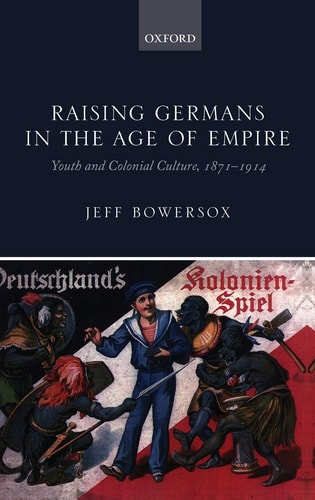
Raising Germans in the Age of Empire: Youth and Colonial Culture, 1871-1914
0
0
As an Amazon Associate and affiliate partner, Menrva Books earns from qualifying purchases. Learn more
Author Description
Raising Germans in the Age of Empire is a cultural history of the German colonial imagination around the turn of the twentieth century. Looking beyond the colonialist movement, it focuses on young Germans who grew up during this era and the various commercial and educational media through which they daily encountered the wider world. Using their imaginary colonial encounters, Jeff Bowersox explores how Germans young and old came to terms with a globalizing world.Chapters on toys, school instruction, popular literature, and the Boy Scouts (or Pfadfinder) reveal how Germans, through mass consumer culture and mass education, built a definitive association between colonial hierarchies and Germany's place in the modern age. By 1914 this colonial sensibility had been accepted as common sense, but it always remained flexible and vague. It could be adapted to serve competing and contradictory purposes, ranging from profit and pedagogical reform to nationalist mobilization and international socialist solidarity. Thus, as young Germans used images of imperialism to construct their own fantastical adventures, adults tried to use those same images to ward off the worst excesses of industrial modernity and to mold young people into capable and productive citizens. The result was a chaotic multitude of imagined empires vying for space in the public arena as Germans debated how best to raise the next generation of children. Raising Germans in the Age of Empire explains how colonial visions not only shaped Germans' engagement with globalization but also determined how they understood themselves as a modern nation.
Menrva's Summary
THE THESIS
How did the German colonial imagination shape the identity of the nation's youth and their understanding of modernity between 1871 and 1914? Jeff Bowersox, a historian specializing in modern German culture, examines the intersection of mass consumerism, educational reform, and imperialist ideology. By analyzing a wide array of media, he argues that colonial imagery served as a flexible tool for adults to mold the next generation while simultaneously allowing children to construct their own global perspectives.
THE SCOPE MAP
What You Will Find
- Analysis of commercial media including toys, popular literature, and school curricula.
- Examination of the German Boy Scouts (Pfadfinder) as a vehicle for colonial socialization.
- Primary source research into the pedagogical and nationalist motivations of the era.
- Exploration of how colonial hierarchies were integrated into the common sense of the German public.
THE AUTHORITY PERSPECTIVE
Historians and scholars of German colonial studies recognize this work as a significant contribution to understanding the domestic impact of imperialism. Experts highlight the text for its detailed examination of how mass culture and education functioned in tandem to define national identity during the Wilhelmine era.
Page Count:
240
Publication Date:
2013-07-12
Publisher:
Oxford University Press
ISBN-10:
0199641099
ISBN-13:
9780199641093
History
Colonialism
Cultural History
Germany
German history
Youth germany
Education
Sociology
Community Tags
Other Editions(2)

Similar Books