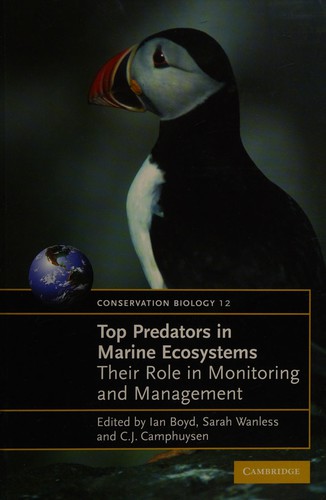
Top Predators in Marine Ecosystems
0
0
As an Amazon Associate and affiliate partner, Menrva Books earns from qualifying purchases. Learn more
Author Description
The sustainable exploitation of the marine environment depends upon our capacity to develop systems of management with predictable outcomes. Unfortunately, marine ecosystems are highly dynamic and this property could conflict with the objective of sustainable exploitation. This book investigates the theory that the population and behavioural dynamics of predators at the upper end of marine food chains can be used to assist with management. Since these species integrate the dynamics of marine ecosystems across a wide range of spatial and temporal scales, they offer new sources of information that can be formally used in setting management objectives. This book examines the current advances in the understanding of the ecology of marine predators and will investigate how information from these species could be used in management. Book jacket.
Menrva's Summary
THE THESIS
This book investigates whether the population and behavioral dynamics of top marine predators can serve as indicators for the sustainable management of marine ecosystems. The author, I. L. Boyd, posits that these apex species integrate ecosystem dynamics across broad spatial and temporal scales, thus providing crucial information for setting management objectives. The book examines recent advancements in understanding the ecology of marine predators and explores practical applications of this knowledge in conservation and resource management. It addresses the inherent conflict between the dynamic nature of marine ecosystems and the need for predictable outcomes in sustainable exploitation.
THE SCOPE MAP
- Analysis of the population dynamics of key marine predator species.
- Examination of predator behavior as an indicator of ecosystem health.
- Theoretical framework for using predator data in fisheries management.
- Case studies integrating predator ecology into conservation strategies.
- Discussion of spatial and temporal scales relevant to predator-ecosystem interactions.
- Advances in the ecological understanding of marine apex predators.
THE AUTHORITY PERSPECTIVE
The book is presented as a theoretical investigation into the utility of top marine predators for ecosystem management. Its focus on integrating ecological data with management objectives suggests a text aimed at researchers, conservationists, and policymakers in marine science. The premise indicates a rigorous scientific approach, likely drawing on empirical data and ecological modeling to support its arguments. The work appears to contribute to the ongoing discourse on sustainable resource utilization in dynamic marine environments.
Page Count:
378
Publication Date:
2006-01-01
ISBN-10:
052161256X
ISBN-13:
9780521612562
Non-Fiction
Science
Animals
Marine Biology
Ecology
Conservation
Community Tags
Similar Books