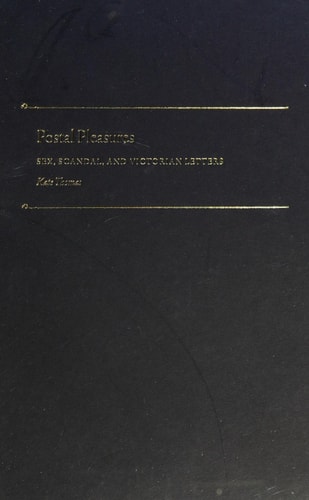
Postal Pleasures: Sex, Scandal, and Victorian Letters
0
0
As an Amazon Associate and affiliate partner, Menrva Books earns from qualifying purchases. Learn more
Author Description
In 1889 uniformed post-boys were discovered moonlighting in a West End brothel frequented by men of the upper classes. "The Cleveland Street Scandal" erupted and Victorian Britain faced the possibility that the Post Office-a bureaucratic backbone of nation and empire-was inspiring and servicing subversive sexual behavior. However, the unlikely alliance between sex and the postal service was not exactly the news the sensational press made it out to be. Postal Pleasures explores the relationship between illicit sex and the Royal Mail from reforms initiated in 1840 up to the imperial end of the nineteenth century. With a combination of historical details and literary analyses, Kate Thomas illustrates how the postal network, its uniformed employees, and its material trappings-envelopes, postmarks, stamps-were used to signal and circulate sexual intrigue. For many, the idea of an envelope promiscuously jostling its neighbors in a post boy's bag, or the notion that secrets passed through the eyes and fingers of telegraph girls, was more stimulating than the actual contents of correspondence. Writers like Anthony Trollope, Eliza Lynn Lynton, Henry James, Oscar Wilde, Arthur Conan Doyle, and others, invoked the postal system as both an instrument and a metaphor for sexual relations that crossed and double-crossed lines of class, marriage, and heterosexuality. Postal Pleasures adds a new dimension to studies of the era as it uncovers the unlikely linkage between the Victorian Post Office and the queer networks it inspired.
Menrva's Summary
THE THESIS
This book investigates the intersection of the Victorian postal system and illicit sexual networks, questioning how a bureaucratic institution became a conduit for subversive desire. Kate Thomas, a scholar of Victorian literature and culture, utilizes a combination of archival historical records and literary analysis to argue that the Royal Mail was not merely a neutral infrastructure but a material participant in the era's sexual intrigue. By examining the physical components of the post—envelopes, stamps, and postmarks—alongside the labor of postal workers, the author reveals how the system facilitated communication across rigid class and social boundaries.
THE SCOPE MAP
What You Will Find
- Historical analysis of the Cleveland Street Scandal and its impact on Victorian public perception.
- Examination of the postal system as a metaphor for sexual relations in the works of authors such as Oscar Wilde and Henry James.
- Investigation into the role of postal employees, including post-boys and telegraph girls, in navigating illicit social spaces.
- Analysis of how material postal objects like envelopes and stamps functioned as symbols of secrecy and desire.
THE AUTHORITY PERSPECTIVE
Scholars and historians recognize this work as a significant contribution to the study of Victorian material culture and queer history. Readers frequently note the academic rigor of the prose, which effectively bridges the gap between literary criticism and social history.
Page Count:
264
Publication Date:
2011-12-16
Publisher:
Oxford University Press
ISBN-10:
0199730911
ISBN-13:
9780199730919
History
Social History
Gender Studies
Victorian History
Scandals
Queer Studies
Letter Writing
Homosexuality history
Great Britain