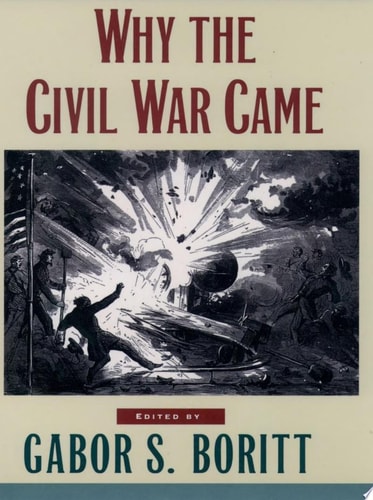
Why the Civil War Came (Gettysburg Civil War Institute Books)
0
0
As an Amazon Associate and affiliate partner, Menrva Books earns from qualifying purchases. Learn more
Author Description
In the early morning of April 12, 1861, Captain George S. James ordered the bombardment of Fort Sumter, beginning a war that would last four horrific years and claim a staggering number of lives. Since that fateful day, the debate over the causes of the American Civil War has never ceased. What events were instrumental in bringing it about? How did individuals and institutions function? What did Northerners and Southerners believe in the decades of strife preceding the war? What steps did they take to avoid war? Indeed, was the great armed conflict avoidable at all?Why the Civil War Came brings a talented chorus of voices together to recapture the feel of a very different time and place, helping the reader to grasp more fully the commencement of our bloodiest war. From William W. Freehling's discussion of the peculiarities of North American slavery to Charles Royster's disturbing piece on the combatants' savage readiness to fight, the contributors bring to life the climate of a country on the brink of disaster. Mark Summers, for instance, depicts the tragically jubilant first weeks of Northern recruitment, when Americans on both sides were as yet unaware of the hellish slaughter that awaited them. Glenna Matthews underscores the important war-catalyzing role played by extraordinary public women, who proved that neither side of the Mason-Dixon line was as patriarchal as is thought. David Blight reveals an African-American world that "knew what time it was," and welcomed war. And Gabor Boritt examines the struggle's central figure, Lincoln himself, illuminating in the years leading up to the war a blindness on the future president's part, an unwillingness to confront the looming calamity that was about to smash the nation asunder.William E. Gienapp notes perhaps the most unsettling fact about the Civil War, that democratic institutions could not resolve the slavery issue without resorting to violence on an epic scale. With gripping detail, Why the Civil War Came takes
Menrva's Summary
THE THESIS
This collection of essays investigates the complex political, social, and institutional failures that rendered the American Civil War an unavoidable catastrophe. Edited by Gabor S. Boritt, a distinguished historian of the Lincoln era, the volume compiles research from several prominent scholars to analyze the climate of the United States in the decades preceding 1861. The contributors examine whether democratic mechanisms were inherently insufficient to resolve the moral and economic crisis of slavery, ultimately arguing that the nation's descent into conflict was driven by a combination of institutional paralysis and individual miscalculations.
THE SCOPE MAP
What You Will Find
- Analysis of the role of slavery as a primary catalyst for sectional division.
- Examination of the psychological and cultural readiness for combat among Northern and Southern populations.
- Historical case studies on the influence of public women and African-American perspectives on the war's onset.
- Critical assessment of Abraham Lincoln's early political foresight and his initial failure to grasp the scale of the impending crisis.
THE AUTHORITY PERSPECTIVE
Experts recognize this volume as a significant contribution to the historiography of the Civil War's origins, particularly for its multi-faceted approach to the political climate of the era. Readers frequently note the academic rigor of the essays, which provide a nuanced understanding of why democratic institutions failed to prevent the conflict.
Page Count:
277
Publication Date:
1996-01-01
Publisher:
Oxford University Press
ISBN-10:
0199879621
ISBN-13:
9780199879625
History
Military History
Political History
19th Century
American History
Community Tags
Similar Books