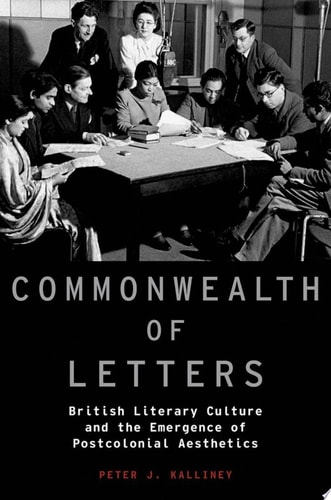
Commonwealth of Letters: British Literary Culture and the Emergence of Postcolonial Aesthetics
0
0
As an Amazon Associate and affiliate partner, Menrva Books earns from qualifying purchases. Learn more
Author Description
Commonwealth of Letters examines midcentury literary institutions integral to modernism and postcolonial writing. Several organizations central to interwar modernism, such as the BBC, influential publishers, and university English departments, became important sites in the emergence of postcolonial literature after the war. How did some of modernism's leading figures of the 1930s-such as T.S. Eliot, Louis MacNeice, and Stephen Spender-come to admire late colonial and early postcolonial literature in the 1950s? Similarly, why did late colonial and early postcolonial writers-including Chinua Achebe, Kamau Brathwaite, Claude McKay, and Ngugi wa Thiong'o-actively seek alliances with metropolitan intellectuals? Peter Kalliney's original and extensive archival work on modernist cultural institutions demonstrates that this disparate group of intellectuals had strong professional incentives to treat one another more as fellow literary professionals, and less as political or cultural antagonists.Surprisingly, metropolitan intellectuals and their late colonial counterparts leaned heavily on modernist theories of aesthetic autonomy to facilitate their collaborative ventures. For white, metropolitan writers, T.S. Eliot's notion of impersonality could help recruit new audiences and conspirators from colonized regions of the world. For black, colonial writers, aesthetic autonomy could be used to imagine a literary sphere uniquely resistant to the forms of racial prejudice endemic to the colonial system. This strategic collaboration did not last forever, but as Commonwealth of Letters shows, it left a lasting imprint on the ultimate disposition of modernism and the evolution of postcolonial literature.
Menrva's Summary
THE THESIS
This book investigates how midcentury literary institutions facilitated a strategic, professional alliance between metropolitan modernist writers and emerging postcolonial authors. Peter J. Kalliney, an expert in modernist and postcolonial studies, utilizes extensive archival research to challenge the assumption that these groups were primarily cultural antagonists. By examining the roles of the BBC, academic departments, and publishing houses, he argues that both parties utilized modernist theories of aesthetic autonomy to navigate the shifting political landscape of the mid-twentieth century.
THE SCOPE MAP
What You Will Find
- Analysis of midcentury cultural institutions including the BBC and university English departments.
- Examination of the professional incentives driving collaboration between metropolitan and colonial intellectuals.
- Application of modernist theories, such as T.S. Eliot's concept of impersonality, to postcolonial literary production.
- Case studies of prominent figures including T.S. Eliot, Chinua Achebe, Louis MacNeice, and Ngugi wa Thiong'o.
THE AUTHORITY PERSPECTIVE
Scholars frequently cite this work as a significant contribution to the study of institutional modernism and the development of postcolonial aesthetics. Experts highlight the book's rigorous archival approach as a foundational resource for understanding the complex professional networks that shaped twentieth-century literature.
Page Count:
336
Publication Date:
2013-08-27
Publisher:
Oxford University Press
ISBN-10:
0199977976
ISBN-13:
9780199977970
British literature
English literature
Cultural History
Literary Criticism
Modernism
Literature
Community Tags
Similar Books