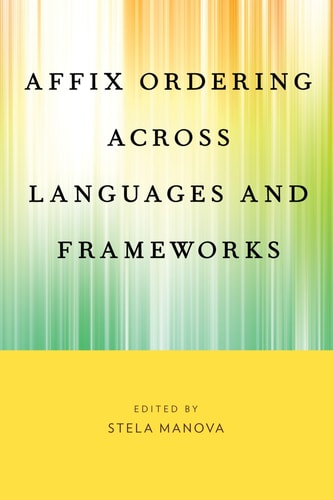
Affix Ordering Across Languages and Frameworks
0
0
As an Amazon Associate and affiliate partner, Menrva Books earns from qualifying purchases. Learn more
Author Description
This volume advances our understanding of how word structure in terms of affix ordering is organized in the languages of the world. A central issue in linguistic theory, affix ordering receives much attention amongst the research community, though most studies deal with only one language. By contrast, the majority of the chapters in this volume consider more than one language and provide data from typologically diverse languages, some of which are examined for the first time. Many chapters focus on cases of affix ordering that challenge linguistic theory with such phenomena as affix repetition and variable ordering, both of which are shown to be neither rare nor typical only of lesser-studied languages with unstable grammatical organization, as previously assumed. The book also offers an explicit discussion on the non-existence of phonological affix ordering, with a focus on mobile affixation, and one on the emergence of affix ordering in child language, the first of its kind in the literature. Repetitive operations, undesirable in many theories, are frequent in early child language and seem to serve as trainings for morphological decomposition and affix stacking. Thus, the volume also raises important questions regarding the general architecture of grammar and the nature and side effects of our theoretical assumptions.
Menrva's Summary
THE THESIS
This volume investigates the structural principles governing affix ordering across diverse global languages to challenge existing theoretical assumptions about morphological organization. Stela Manova compiles research that moves beyond single-language studies, utilizing typologically varied data to examine complex phenomena such as affix repetition and variable ordering. The work evaluates the architecture of grammar by questioning the necessity of phonological constraints and exploring the developmental emergence of affix stacking in child language.
THE SCOPE MAP
What You Will Find
- Comparative analyses of affix ordering across multiple typologically diverse languages
- Examination of non-standard morphological phenomena including affix repetition and variable ordering
- Theoretical discussion on the absence of phonological affix ordering and the role of mobile affixation
- Empirical study on the emergence of morphological decomposition in child language acquisition
Scope Limits
- The text does not provide a comprehensive survey of every known language family
- It does not offer a singular, unified theory of morphology but rather critiques existing frameworks
THE AUTHORITY PERSPECTIVE
Experts recognize this volume as a significant contribution to morphological theory due to its focus on cross-linguistic data rather than isolated language studies. Readers frequently note the academic density of the prose, which is intended for researchers and advanced students of linguistics.
Page Count:
304
Publication Date:
2014-01-01
Publisher:
Oxford University Press
ISBN-10:
0190210443
ISBN-13:
9780190210441
English & College Success
Academic
Linguistics
English
Morphology
Grammar