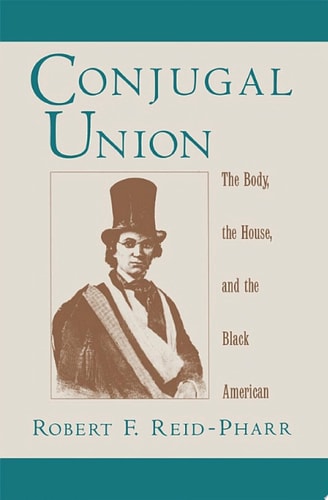
Conjugal Union: The Body, the House, and the Black American
0
0
As an Amazon Associate and affiliate partner, Menrva Books earns from qualifying purchases. Learn more
Author Description
In Conjugal Union, Robert F. Reid-Pharr argues that during the antebellum period a community of free black northeastern intellectuals sought to establish the stability of a Black American subjectivity by figuring the black body as the necessary antecedent to any intelligible Black American public presence. Reid-Pharr goes on to argue that the fact of the black body's constant and often spectacular display demonstrates an incredible uncertainty as to that body's status. Thus antebellum black intellectuals were always anxious about how a stable relationship between the black community might be maintained. Paying particular attention to Black American novels written before the Civil War, the author shows how the household was utilized by these writers to normalize this relationship of body to community such that a person could enter a household as a white and leave it as a black.
Menrva's Summary
THE THESIS
How did antebellum Black intellectuals utilize the concepts of the body and the household to construct a stable Black American subjectivity? Robert F. Reid-Pharr, a scholar of African American literature and culture, examines the intersection of racial identity and domestic space in the nineteenth century. He argues that these intellectuals positioned the Black body as a foundational element for public presence, while simultaneously using the household as a mechanism to normalize and stabilize racial identity during a period of intense social uncertainty.
THE SCOPE MAP
What You Will Find
- Analysis of antebellum Black American novels and literature.
- Theoretical framework linking the physical body to the domestic sphere.
- Examination of the anxieties surrounding Black subjectivity in the pre-Civil War era.
Scope Limits
- The text focuses primarily on the intellectual output of free Black northeasterners.
- It does not provide a comprehensive history of all Black American experiences during the antebellum period.
THE AUTHORITY PERSPECTIVE
Scholars frequently cite this work as a significant contribution to the study of racial formation and domesticity in American literature. Readers often note the dense, theoretical nature of the prose, which is typical of advanced academic discourse in cultural studies.
Page Count:
176
Publication Date:
1999-01-01
Publisher:
Oxford University Press
ISBN-10:
0190282959
ISBN-13:
9780190282950
History
Sociology
African American
Literary Criticism
Ethnic Studies
English
English & College Success
United States
Community Tags
Similar Books