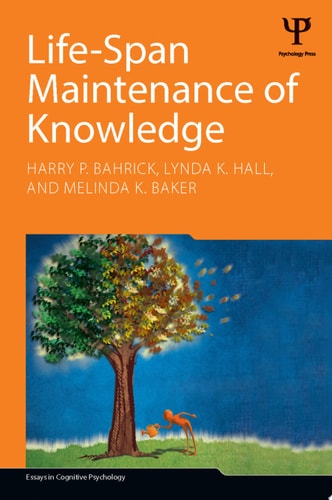
Life-Span Maintenance of Knowledge
0
0
As an Amazon Associate and affiliate partner, Menrva Books earns from qualifying purchases. Learn more
Author Description
This volume describes how well we maintain the knowledge we acquire throughout life. Research traditionally focuses on memory for events that are retained over short time periods that can be accommodated in experiments. This book, by contrast, uniquely describes the evolution of methods suitable for investigating memory of complex knowledge acquired over several years and retained during the entire life-span. The methods substitute statistical for experimental controls, and the investigations involve several hundred participants whose memory is tested up to 50 years after they acquired the knowledge in question. The book covers educational content, such as mathematics and foreign languages; knowledge acquired incidentally, such as the streets and buildings of the city in which we live; and knowledge acquired through the media. Previously unpublished research on age-related access to knowledge is included. The analyses are based on the accessibility/availability ratio, a metric presented for the first time. This metric allows comparisons of the portion of available knowledge that can be recalled as a function of age, education and other individual differences, and as a function of the domain of knowledge in question. The ratio can be used to evaluate methods of instruction and methods of studying. It can also be used to evaluate memory development and to diagnose memory pathology. The volume will be of interest to researchers in human memory, developmental psychologists, gerontologists in academic and applied settings, and educators.
Menrva's Summary
THE THESIS
This volume investigates the long-term retention of complex knowledge acquired over a lifetime, challenging traditional experimental limitations on memory research. The authors, led by Harry P. Bahrick, utilize longitudinal data from hundreds of participants to track memory performance across decades. By shifting from short-term experimental controls to statistical analysis of real-world knowledge, the text introduces the accessibility/availability ratio as a primary metric for evaluating memory decay and retention across various domains.
THE SCOPE MAP
What You Will Find
- Longitudinal analysis of knowledge retention spanning up to 50 years.
- The introduction and application of the accessibility/availability ratio metric.
- Comparative studies on memory performance across different educational backgrounds and age groups.
- Investigations into diverse knowledge domains including academic subjects, incidental environmental learning, and media-acquired information.
THE AUTHORITY PERSPECTIVE
Experts recognize this work as a foundational text for researchers in human memory and developmental psychology due to its unique longitudinal methodology. Readers frequently note the academic density of the prose, which serves as a specialized resource for professionals in gerontology and educational assessment.
Page Count:
310
Publication Date:
2013-01-01
Publisher:
Taylor & Francis Group
ISBN-10:
0203141075
ISBN-13:
9780203141076
Psychology
Gerontology
Memory
Developmental Psychology
Education