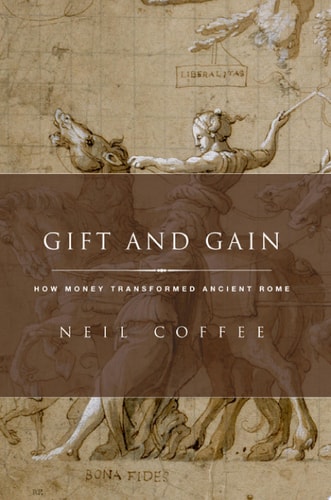
Gift and Gain: How Money Transformed Ancient Rome
0
0
As an Amazon Associate and affiliate partner, Menrva Books earns from qualifying purchases. Learn more
Author Description
The economy of ancient Rome, with its long-range trade, widespread moneylending, and companies of government contractors, was surprisingly modern. Yet Romans also exchanged goods and services within a traditional system of gifts and favors, which sustained the supportive relationships necessary for survival in the absence of extensive state and social institutions. In Gift and Gain: How Money Transformed Ancient Rome, Neil Coffee shows how a vibrant commercial culture progressively displaced systems of gift giving over the course of Rome's classical era. The change was propelled by the Roman elite, through their engagement in a variety of profit-making enterprises. Members of the same elite, however, remained habituated to traditional gift relationships, relying on them to exercise influence and build their social worlds. They resisted the transformation, through legislation, political movements, and philosophical argument. The result was a recurring clash across the contexts of Roman social and economic life. Neil Coffee's comprehensive volume traces the conflict between gift and gain from Rome's prehistory down through the conflicts of the late Republic and into the early Empire, showing its effects in areas as diverse as politics, law, philosophy, personal and civic patronage, marriage, and the Latin language. These investigations show Rome shifting, unevenly but steadily, away from its pre-historic reliance on mutual aid and toward the sort of commercial and contractual relations typical of the modern world.
Menrva's Summary
THE THESIS
This book investigates how the transition from traditional gift-based social structures to a modern commercial economy fundamentally altered the social and political landscape of ancient Rome. Neil Coffee, a scholar of classical culture, utilizes a wide array of historical, legal, and literary evidence to argue that the Roman elite navigated a persistent tension between profit-seeking and the maintenance of traditional patronage networks. The work posits that this conflict was not merely economic but deeply embedded in the philosophical and political fabric of Roman life from the Republic through the early Empire.
THE SCOPE MAP
What You Will Find
- Analysis of the shift from mutual aid systems to contractual, market-based relations.
- Examination of how Roman legislation and political movements reflected resistance to commercialization.
- Investigation into the impact of economic change on diverse areas such as marriage, law, and the Latin language.
Scope Limits
- The text focuses primarily on the Roman elite and their specific social spheres rather than the daily economic lives of the lower classes.
- It does not provide a comprehensive macroeconomic history of the Roman Empire but rather a cultural history of economic transformation.
THE AUTHORITY PERSPECTIVE
Scholars recognize this volume as a significant contribution to the study of Roman social history and economic behavior. The text is noted for its ability to bridge the gap between classical philology and modern economic theory for an academic audience.
Page Count:
312
Publication Date:
2016-01-01
Publisher:
Oxford University Press
ISBN-10:
0190655941
ISBN-13:
9780190655945
History
Rome
Social History
Ancient - Rome
Economics history
Money rome
Sociology
Economic History
Ancient History
Community Tags
Other Editions(2)
Similar Books