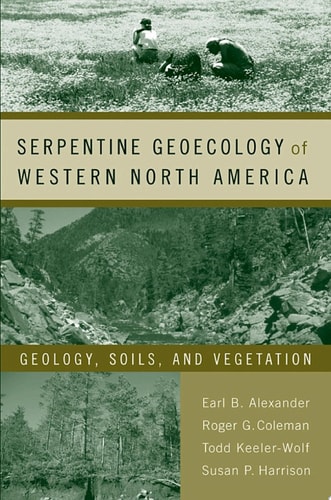
Serpentine Geoecology of Western North America: Geology, Soils, and Vegetation
0
0
As an Amazon Associate and affiliate partner, Menrva Books earns from qualifying purchases. Learn more
Author Description
Geoecology is a fruitful interdisciplinary field, relating rocks to soils to plant and animal communities and studying the interactions between them. Modern geoecology especially concentrates on showing how geology and soils affect the structure, composition, and distribution of plant communities in a certain research area. This book applies the principles of geoecology to Western North America, and to a specific kind of rock, the fascinating serpentine belts that run along the continental margins of the West Coast from Alaska to Baja. The authors come from different disciplines: Alexander is a soil scientist, Coleman a geologist, Harrison a biological researcher, and Keeler-Wolfe a vegetation ecologist. It begins with an overview of the geology of this rock and this region, covering mineralogy, petrology, and stratigraphy of West Coast serpentine. It will continue with serpentine soils and their development and distribution, and serpentine effects on plants and vegetation and animals. The serpentine geoecology of the different regions of Western North America, concentrating on California, will conclude the study. So, this academic book should appeal to plant ecologists, soil scientists, researchers in geoecology, and students in advanced courses in soil science.
Menrva's Summary
THE THESIS
This book investigates the complex interdisciplinary relationships between serpentine rock formations, soil development, and the resulting plant and animal communities across Western North America. The authors, a collaborative team of a soil scientist, a geologist, a biological researcher, and a vegetation ecologist, utilize a multi-faceted framework to demonstrate how specific geological substrates dictate the structure and distribution of regional ecosystems. By integrating mineralogy, pedology, and plant ecology, the text provides a comprehensive analysis of how serpentine belts influence biological diversity along the Pacific coast.
THE SCOPE MAP
What You Will Find
- Detailed analysis of the mineralogy, petrology, and stratigraphy of West Coast serpentine belts.
- Examination of soil development processes specific to ultramafic rock environments.
- Assessment of the physiological and ecological effects of serpentine soils on vegetation and fauna.
- Regional case studies focusing on the geoecology of California and the broader Western North American corridor.
Scope Limits
- The text focuses primarily on the Western North American region and does not provide a global survey of serpentine geoecology.
- The content is tailored for advanced academic audiences and assumes prior knowledge of geological and ecological principles.
THE AUTHORITY PERSPECTIVE
Experts identify this work as a foundational interdisciplinary reference for researchers and students specializing in soil science and plant ecology. Readers frequently note the technical density of the prose, which effectively bridges the gap between geological data and biological outcomes.
Page Count:
519
Publication Date:
2006-01-01
Publisher:
Oxford University Press
ISBN-10:
0190290056
ISBN-13:
9780190290054
Science
Ecology
Botany
Soil Science
Geology
Community Tags
Similar Books