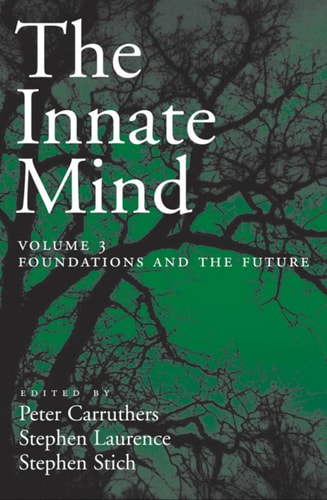
The Innate Mind: Volume 3: Foundations and the Future
0
0
As an Amazon Associate and affiliate partner, Menrva Books earns from qualifying purchases. Learn more
Author Description
This is the third volume of a three-volume set on The Innate Mind. The extent to which cognitive structures, processes, and contents are innate is one of the central questions concerning the nature of the mind, with important implications for debates throughout the human sciences. By bringing together the top nativist scholars in philosophy, psychology, and allied disciplines these volumes provide a comprehensive assessment of nativist thought and a definitive reference point for future nativist inquiry. The Innate Mind: Volume 3: Foundations and the Future, concerns a variety of foundational issues as well as questions about the direction of future nativist research. It addresses such questions as: What is innateness? Is it a confused notion? What is at stake in debates between nativists and empiricists? What is the relationship between genes and innateness? How do innate structures and learned information interact to produce adult forms of cognition, e.g. about number, and how does such learning take place? What innate abilities underlie the creative aspect of language, and of creative cognition generally? What are the innate foundations of human motivation, and of human moral cognition? In the course of their discussions, many of the contributors pose the question (whether explicitly or implicitly): Where next for nativist research?Together, these three volumes provide the most intensive and richly cross-disciplinary investigation of nativism ever undertaken. They point the way toward a synthesis of nativist work that promises to provide a powerful picture of our minds and their place in the natural order.
Menrva's Summary
THE THESIS
This volume investigates the conceptual foundations of innateness and the prospective trajectory of nativist research within the cognitive sciences. The editors, Peter Carruthers, Stephen Laurence, and Stephen P. Stich, curate a collection of essays from prominent scholars in philosophy and psychology to evaluate the extent to which cognitive structures are innate. The text synthesizes diverse disciplinary perspectives to clarify the debate between nativists and empiricists regarding the architecture of the human mind.
THE SCOPE MAP
What You Will Find
- Philosophical analysis of the definition and validity of the concept of innateness
- Examination of the interaction between genetic factors and learned information in cognitive development
- Investigations into innate foundations of language, numerical cognition, motivation, and moral reasoning
- Discussions on the future direction of nativist research methodologies
Scope Limits
- Does not provide a singular, unified theory of mind but rather a collection of diverse scholarly viewpoints
- Focuses primarily on theoretical and conceptual frameworks rather than clinical or therapeutic applications
THE AUTHORITY PERSPECTIVE
Experts recognize this volume as a significant contribution to the ongoing dialogue between philosophy and the cognitive sciences. Readers frequently note the academic density of the prose, which is intended for researchers and advanced students in the field of cognitive architecture.
Page Count:
454
Publication Date:
2008-01-01
Publisher:
Oxford University Press
ISBN-10:
0190450339
ISBN-13:
9780190450335
Philosophy
Psychology
Nativism
Evolutionary Psychology
Mind & Body
Epistemology
Community Tags
Other Editions(2)
Similar Books













Reader Comments
Share Your Thoughts
No comments yet. Be the first to share your thoughts!