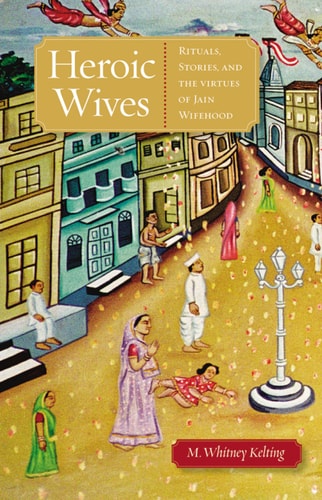
Heroic Wives: Rituals, Stories, and the Virtues of Jain Wifehood
0
0
As an Amazon Associate and affiliate partner, Menrva Books earns from qualifying purchases. Learn more
Author Description
Although in Hinduism it is mainly used to refer to widow immolation, the term 'sati' means 'true woman' - a female hero. Whitney Kelting has learned that in Jainism satis appear as subjects of devotional hymns. This seems paradoxical, given that Jain spirituality is to disengage oneself from worldly existence and Jain devotionalism is usually directed toward those souls who have reached perfect detachment. In fact, however, there is a vast corpus of popular texts, many of them written by prominent scholar-monks between the 16th and 18th centuries, illustrating the distinctly worldly virtues of devoted Jain wives. In this fieldwork-based study, Kelting explores the ways in which Jain women use sati narratives and rituals to understand wifehood as a choice, which these women's ongoing ritual practices continually shape. She focuses on eight well-known Jain sati narratives, recorded in both formal ritual contexts and in informal retellings, and also as read aloud from printed versions. She finds that one of the principal functions of Jain sati narratives is to contribute to a discourse of wifehood, which addresses the concerns of Jain laywomen within the Jain value system and provides a fertile context in which Jain women can explore their questions of virtue and piety.
Menrva's Summary
THE THESIS
This study investigates the paradoxical role of the 'sati' figure within Jainism, questioning how a tradition centered on detachment reconciles the veneration of devoted wives with its spiritual goals. M. Whitney Kelting, an expert in Jain studies, utilizes extensive fieldwork and an analysis of historical texts written by scholar-monks between the 16th and 18th centuries. She argues that these narratives serve as a functional discourse for Jain laywomen, allowing them to navigate the complexities of piety and virtue within their specific social and religious framework.
THE SCOPE MAP
What You Will Find
- Analysis of eight primary Jain sati narratives.
- Examination of devotional hymns and popular texts from the 16th to 18th centuries.
- Fieldwork-based observations of ritual practices and informal storytelling.
- Exploration of the intersection between domestic life and Jain ascetic values.
Scope Limits
- The study does not focus on the broader Hindu interpretations of 'sati' beyond the initial conceptual contrast.
- It does not provide a comprehensive history of Jainism, focusing instead on the specific discourse of wifehood.
THE AUTHORITY PERSPECTIVE
Scholars in the field of South Asian religions recognize this work as a significant contribution to understanding the lived experience of Jain women. Readers frequently note the academic rigor and the clarity with which the author bridges the gap between formal theological texts and informal ritual practice.
Page Count:
265
Publication Date:
2009-01-01
Publisher:
Oxford University Press
ISBN-10:
0190452862
ISBN-13:
9780190452865
Religion
Womens Studies
Special Topics
Anthropology
Sociology of Religion
Jainism
Community Tags
Similar Books