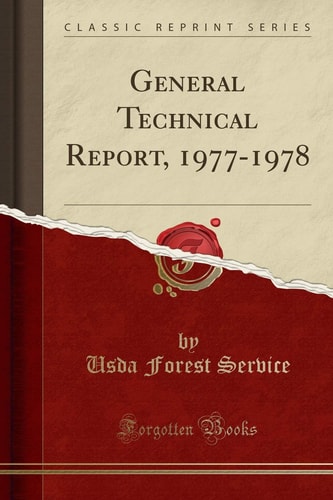
General Technical Report, 1977-1978
0
0
As an Amazon Associate and affiliate partner, Menrva Books earns from qualifying purchases. Learn more
Author Description
Excerpt from General Technical Report, 1977-1978 Natural resource managers and researchers in Montana have found that existing for est cover-type classifications and site classifications have not been adequate for their needs. Forest cover-type classifications are based only on the current (often early successional) tree species. Thus, they often encompass a wide range of environmental conditions; for example, one cover type might include saplings on clearcut sites in one environment and 400-year-old climax forests in a totally different environment. More over, the cover type on a given site is always changing with advancing succession or sudden disturbance (such as fire, logging, insect damage, or windthrow). Existing site classifications are usually of limited value because they are in tended for use in a certain resource specialty. Also, they often have little relation to forest vegetation, even though the vegetation represents a detailed expression of the overall environment and is itself a primary object of management. About the Publisher Forgotten Books publishes hundreds of thousands of rare and classic books. Find more at www.forgottenbooks.com This book is a reproduction of an important historical work. Forgotten Books uses state-of-the-art technology to digitally reconstruct the work, preserving the original format whilst repairing imperfections present in the aged copy. In rare cases, an imperfection in the original, such as a blemish or missing page, may be replicated in our edition. We do, however, repair the vast majority of imperfections successfully; any imperfections that remain are intentionally left to preserve the state of such historical works.
Menrva's Summary
THE THESIS
The need for improved forest cover-type and site classifications for natural resource managers and researchers is examined. The existing classifications are found to be inadequate because they rely solely on current tree species, failing to account for diverse environmental conditions or the dynamic nature of forest succession and disturbance. Furthermore, existing site classifications are often too specialized and lack a strong connection to forest vegetation, which itself is a direct indicator of the environment and a key management objective. This report addresses these limitations by exploring alternative approaches to classifying forest resources.
THE SCOPE MAP
- Analysis of the limitations of current forest cover-type classifications.
- Critique of existing site classification systems and their applicability.
- Discussion on the dynamic nature of forest vegetation and its impact on classification.
- Exploration of the relationship between environmental conditions and forest vegetation.
- Consideration of the needs of natural resource managers and researchers.
- Examination of how vegetation reflects the overall environment.
- Potential for improved classification systems for forest management.
THE AUTHORITY PERSPECTIVE
This report addresses a specific technical challenge faced by natural resource managers and researchers in Montana regarding forest classification systems. It highlights the shortcomings of existing methods, particularly their reliance on transient vegetation states and their disconnect from broader environmental factors. The work aims to provide a foundation for developing more effective classification tools that better integrate ecological principles and management needs.
Page Count:
778
Publication Date:
2018-03-19
Publisher:
Fb&c Limited
ISBN-10:
0483389005
ISBN-13:
9780483389007
Science
Non-Fiction
Ecology
Forestry
Community Tags
Similar Books