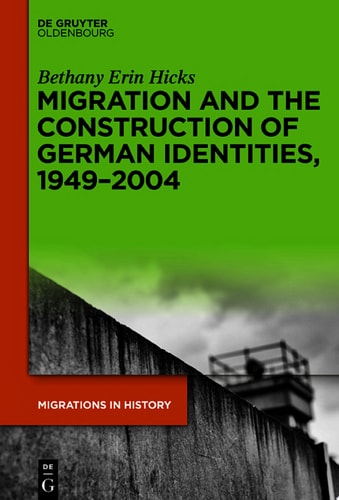
Migration and the Construction of German Identities, 1949–2004
0
0
As an Amazon Associate and affiliate partner, Menrva Books earns from qualifying purchases. Learn more
Author Description
Migration, in its many forms, has often been found at the center of public and private discourse surrounding German nationalism and identity, significantly influencing how both states construct conceptions of what it means to be "German" at any given place and time. The attempt at constructing an ethnically homogeneous Third Reich was shattered by the movement of refugees, expellees, and soldiers in the aftermath of the Second World War, and the contracting of foreign nationals as Gastarbeiter in the Federal Republic and Vertragsarbeiter in the German Democratic Republic in the 1960s and 70s diversified the ethnic landscape of both Cold War German states during the latter half of the Cold War. Bethany Hicks shows how the regional migration of East Germans into the western federal states both during and after German unification challenged essential Cold War assumptions concerning the ability to integrate two very different German populations.
Menrva's Summary
THE THESIS
This book investigates how migration has shaped the construction of German national identity from the end of World War II through the early 21st century. It examines the impact of post-war refugee movements, the integration of 'Gastarbeiter' and 'Vertragsarbeiter', and the internal migration of East Germans following unification, demonstrating how these demographic shifts challenged and redefined what it meant to be German in both the Federal Republic and the German Democratic Republic.
THE SCOPE MAP
- Analysis of post-WWII refugee and expellee movements and their impact on German identity.
- Examination of the role of 'Gastarbeiter' (guest workers) in West Germany and 'Vertragsarbeiter' (contract workers) in East Germany during the 1960s and 70s.
- Exploration of the internal migration of East Germans to the West during and after unification.
- Discussion of how these migration patterns influenced the construction of national identity in both German states.
- Focus on the period from 1949 to 2004, covering key phases of German post-war history.
- Explores the intersection of migration, nationalism, and the concept of 'Germanness'.
THE AUTHORITY PERSPECTIVE
The book examines the complex interplay between migration and the evolving concept of German national identity in the post-war era. It details how various waves of migration, from post-war refugees to guest workers and internal East-West movement, fundamentally altered perceptions of 'Germanness'. The analysis highlights the challenges these demographic shifts posed to Cold War assumptions about integration and national homogeneity. The work contributes to a deeper understanding of how migration experiences have been central to the discourse on German nationalism and identity construction.
Page Count:
167
Publication Date:
2023-10-24
Publisher:
Walter de Gruyter GmbH & Co KG
ISBN-10:
3110716224
ISBN-13:
9783110716221
Non-Fiction
History
German Studies
Sociology
National Identity