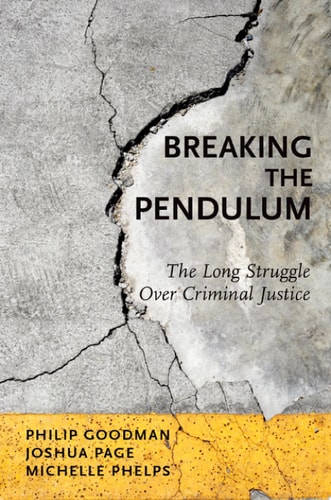
Breaking the Pendulum: The Long Struggle Over Criminal Justice
0
0
As an Amazon Associate and affiliate partner, Menrva Books earns from qualifying purchases. Learn more
Author Description
The history of criminal justice in the U.S. is often described as a pendulum, swinging back and forth between strict punishment and lenient rehabilitation. While this view is common wisdom, it is wrong. In Breaking the Pendulum, Philip Goodman, Joshua Page, and Michelle Phelps systematically debunk the pendulum perspective, showing that it distorts how and why criminal justice changes. The pendulum model blinds us to the blending of penal orientations, policies, and practices, as well as the struggle between actors that shapes laws, institutions, and how we think about crime, punishment, and related issues.Through a re-analysis of more than two hundred years of penal history, starting with the rise of penitentiaries in the 19th Century and ending with ongoing efforts to roll back mass incarceration, the authors offer an alternative approach to conceptualizing penal development. Their agonistic perspective posits that struggle is the motor force of criminal justice history. Punishment expands, contracts, and morphs because of contestation between real people in real contexts, not a mechanical "swing" of the pendulum. This alternative framework is far more accurate and empowering than metaphors that ignore or downplay the importance of struggle in shaping criminal justice.This clearly written, engaging book is an invaluable resource for teachers, students, and scholars seeking to understand the past, present, and future of American criminal justice. By demonstrating the central role of struggle in generating major transformations, Breaking the Pendulum encourages combatants to keep fighting to change the system.
Menrva's Summary
THE THESIS
This book investigates the historical development of the American criminal justice system by challenging the popular 'pendulum' metaphor that suggests a cyclical oscillation between punishment and rehabilitation. The authors, Philip Goodman, Joshua Page, and Michelle Phelps, utilize a sociological framework to argue that penal change is not a mechanical process but rather the result of ongoing, agonistic struggle between various social actors. By re-examining two centuries of penal history, they demonstrate that policy shifts are driven by active contestation rather than abstract, inevitable swings.
THE SCOPE MAP
What You Will Find
- A comprehensive re-analysis of over two hundred years of American penal history.
- The 'agonistic perspective' framework for understanding institutional change.
- Case studies ranging from the 19th-century rise of penitentiaries to contemporary mass incarceration reform.
Scope Limits
- The text focuses primarily on the American context and does not provide a global comparative analysis of penal systems.
- It does not offer a prescriptive policy manual but rather a theoretical lens for historical interpretation.
THE AUTHORITY PERSPECTIVE
Scholars and students of criminology frequently cite this work as a necessary corrective to simplistic historical narratives regarding penal reform. Experts highlight the text for its analytical rigor and its ability to provide a more nuanced understanding of the political forces that shape criminal justice policy.
Page Count:
233
Publication Date:
2017-01-01
Publisher:
Oxford University Press
ISBN-10:
0190676817
ISBN-13:
9780190676810
History
Sociology
American History
Professional Career & Trade
Criminology
Community Tags
Other Editions(2)
Similar Books








Reader Comments
Share Your Thoughts
No comments yet. Be the first to share your thoughts!